Showing posts with label storm-for-gis. Show all posts

Strange Weather

Sydney


Continuing a visual meme of late, above is a thick vermillion fog re-landscaping the city of Sydney anew. Writes The Sydney Morning Herald, “Sydneysiders have woken to a red haze unlike anything seen before by residents or weather experts, as the sun struggles to pierce a thick blanket of dust cloaking the city this morning.”

The photograph is just one of hundreds documenting this freak meteorological event. No doubt there will be thousands, perhaps hundreds of thousands, taken before the last grain of sand settles down. And as these images find their way into each and every blog in the universe, alighting twitter, Facebook and forums, and yes, even as they infiltrate the local evening news, the water cooler and the rest of old media, it's worth quoting again from Diller + Scofidio's Blur: The Making of Nothing.

When we speak about weather, it's assumed that more meaningful forms of communication are being avoided. But is not the weather, in fact, a potent topic of cultural exchange - a bond that cuts through social distinction and economic class, that supersedes geological borders? Is not the weather the only truly tangible and meaningful thread that glues us all together? Is not the weather the only truly global issue? In truth, contemporary culture is addicted to weather information. We watch, read, and listen to weather reports across every medium of communication, from conventional print to real-time satellite images and Web cams. The weather channel provides round-the-clock, real-time meteorological entertainment. Boredom is key. But boredom turns to melodrama when something out of the ordinary happens. Major weather events are structured like narrative dramas with anticipation heightened by detection and tracking, leading to the climax of real-time impact, capped by the aftermath of devastation or heroic survival.


Arrangement of Test Specimens at Treat Island Natural Weathering Exposure Station

Treat Island


To register once more our fascination with testing grounds, or sites of experimentation and simulations, here is the rack map of concrete slabs at the U.S. Army Corps of Engineers' materials testing facility at Treat Island, Maine.

On the island, material specimens are exposed to natural severe environmental conditions to test for durability. They are subjected to between 100 and 160 freeze-thaw cycles, cyclic inundation of saltwater and air-drying, chloride intrusion, wetting and drying, and abrasion-erosion. There and in many other testing grounds, arranged in museological, Donald Judd-like intervals of solids and negatives, these perfect geometries are coming undone. The building blocks of future cities and monuments fracture and decay in a way that belies their solidity and intended permanence. Bit by bit, atom by atom, structures get nullified and give way.

Aurora Bibliothèque

Aurora Borealis


“For reasons not fully understood by scientists,” NASA tells us, “the weeks around the vernal equinox are prone to Northern Lights.”

This is a bit of a puzzle. Auroras are caused by solar activity, but the sun doesn’t know what season it is on Earth. So how could one season yield more auroras than another?


To better understand auroras, NASA sent five satellites, collectively called THEMIS, or Time History of Events and Macroscale Interactions during Substorms. During the mission's first year of operations, the satellites have “observed one geomagnetic storm with a total energy of five hundred thousand billion (5 x 10^14) Joules,” which is “approximately equivalent to the energy of a magnitude 5.5 earthquake.” And then there are those so-called magnetic ropes, which are magnetic fields that are “organized much like the twisted hemp of a mariner’s rope connecting Earth's upper atmosphere directly to the sun. Solar wind particles flow along the ropes in whirligig trajectories leading from the sun to Earth.”

To repeat: Solar wind particles flow along the ropes in whirligig trajectories leading from the sun to Earth.

Aurora Borealis


Having recently been alerted by BLDGBLOG to these proposals for the George W. Bush Presidential Library — speculative architecture via air mail; manifestos for $0.41 — we can't help but wonder:

Can you build a library out of auroras?

Can these shimmering ribbons of earthly solarity be turned into a repository of knowledge?

Using a translation matrix yet to be programmed and actuators yet to be invented, you could digitize, say, the entire content of BLDGBLOG into charged electrons and protons, which you would thereafter eject from a fleet of satellites orbiting between the earth and the sun. These particles would then hitch a ride on solar winds, eventually colliding with artificially produced charged particles floating in a finely reconfigured magnetosphere. Writing in the sky with remnants of stars.

Or you could use the satellites to weave and unravel those “magnetic ropes” to manipulate the flow of solar wind particles, as one would strum the strings of a cello to create certain photonic vibrations.

Alternatively, instead of satellites, you could have a gigantic circular struts floating above the poles. Through millions of spray nozzles, charged particles will be exhaled, the amount and timing and direction being determined by a complex algorithm yet to be conceived.

Aurora Borealis


When all things are working (or not working), the polar regions will be alight with the transliterated works of Mr. Manaugh. The whole landscapes singing Homeric tales of undiscovered subterranean rooms, lunar urbanism, buttressed buttresses and magmatic Baroque churches. The still waters of the Icelandic fjords and the hushed glacial fields of Alaska filled with the geomagnetic crackling of encoded artificial islands and algal farms.

However, in order to listen to them — i.e., to read them — patrons would need to use sensors yet to be developed located in spaces yet to be spatialized.

Aurora Borealis


A couple of things:

1) Going back to the original question, should that now ask: can you make auroras out of libraries?

2) Not in a million years did we think that we would ever reference Babylon 5 and Diller+Scofidio in a single sentence in this landscape architecture blog, but our description above reminded us of the Shadow Planet Killer and the Blur Building.

Aurora Borealis


Could Dani Karavan's Negev Desert observatory serve as a model for the library's access terminals?

Aurora Borealis


“But shouldn't libraries be universally accessible?” you might object. “Not everyone can afford the trip. A few can't even stand the cold.”

Very well then. Forget BLDGBLOG — sorry, G! — this will be the new wing of the Vatican Secret Archives, open only to scholars with academic credentials and well-funded fellowships. In fact, forget our north pole, let's make them even more inaccessible and file them on other planets.

Heretical gospels howling by Jupiter's magnetic fields.

Aurora Borealis


For more photos of auroras, check out this Flickr pool.


Goodbye, Alaska!


Vapour City

“On evacuation and atomization uses his self-energy and on drifting atomization sea waters skywards”

Anti-hurricane machine


After going through Josef Solc's website detailing his designs for an anti-hurricane ship, you will most likely come away unconvinced that his machine will actually knock off hurricanes and typhoons dead on their tracks, or that it would at least dampen their cyclonic strength far down to an appreciable level — that is, kill maybe just one or two people and cause a few million dollars in damages instead of wiping off entire cities and slashing in half the GDP of Haiti.

What you might come away with instead — perhaps apart from a strange liking to the guy's beautifully whacky prose, like Yoda attempting Walt Whitman or a UN interpreter on crack — is a suspicion that the whole thing is merely an elaborate Nigerian scam to bait our grandparents anxious to protect their retirement homes from hurricanes and trick incompetent FEMA directors into parting with taxpayers' money to fund useless disaster mitigation schemes.

But in all earnestness, we don't really care. That thing should be built, regardless of buildability, scientific merit and cost.

Anti-hurricane machine


And then instead of sending it out to sea to wait for the next Category 5 storm, you put it on wheels or, better yet, make it hover on its own aeolian power, after which you let it loose on your own private national park, totally misunderstanding the idea that disasters — like wildfires — can sometimes be beneficial and are actually an essential part of an ecosystem.

There, it will scour the landscape like a runaway garden-variety water hose, level trees as if inspired by the Tunguska event or Mount St. Helens post-1980, carve out a new drainage basin, reconfigure ecology with weather.

It's designing with nature.

Shedding all pretense of humanitarianism, then, Josef Solc will probably have to find private individuals to fund his project, for instance, a Hollywood celebrity who wants to balance out his well-publicized acts of philanthropy with something that's completely bizarre (even by the standards of Michael Jackson), something that's disgustingly but forgivably selfish like buying one humongous toy.

Anto-hurricane machine


Why buy silly motorcycles or start up yet another nightclub where you idle your time and money away when you could divert at least a part of your generous profit-sharing deal to making experimental landscapes. And by experimental landscapes we don't mean building artificial volcanoes in the middle of some pimped out Olympic-size swimming pool — though if it did actually spew out part of the Earth's core, that could be interesting.

Not that he has shown other overriding interests apart from furthering his metrosexual lifestyle but we think it would be fantastic to learn nonetheless that David Beckham has bought a sizable chunk of Public Lands in Nevada and plans to retire there as an avant-gardener. Instead of attending present and future Spice Girls reunion concerts, he's out there playing with his anti-hurricane toy, recreating storms past, designing new landscapes.

Instead of Britney Spears as the paradigm for celebrity living, there is a shift towards François Nicolas Henri Racine de Monville as a model for conspicuous consumption.

Obviously, Josef Solc need not ingratiate himself to an eccentric denizen of Los Angeles as there must be a private hedge fund manager, recently flushed with millions of dollars from rising oil prices, who is willing to patronize him, thus initiating the most fruitful patron-artist relationship of the age and engendering some of the most interesting landscape architecture ever — a collaboration not seen since the Sun King hired Le Nôtre or maybe since the popes hired Michelangelo and his contemporaries to remodel the Eternal City.

Instead of buying the latest Hermès satchel, you buy a weather machine.


Portable Hurricane

Portable Hurricane

Portable Hurricane


Our second anniversary is fast approaching, so we've been looking for something to treat ourselves with, the same way we treated ourselves to some passkeys to Kubrickian and Schnitzlerian sex orgies. A very promising candidate comes from the University of Florida: the world's largest portable hurricane wind and rain simulator.

According to the article linked above, the simulator has eight 5-foot-tall industrial fans that can whip up winds up to 130 mph (Category 3 on the Saffir-Simpson Hurricane Scale). Researchers at the university will use it to blast vacant homes not only with hurricane winds but also with high-pressure jets that mimic wind-driven torrential rain.

“The goal: to learn more about exactly how hurricanes damage homes, and how to modify them to best prevent that damage.”


Obviously, we'll have better use for it:

1) Take it to New York during Postopolis! and blast the Storefront to see how well Vito Acconci and Steven Holl can structurally withstand a Category 3, if its configurable façade is supple enough, malleable enough to respond to weather (architecture vs. landscape; objectified forms vs. enigmatic forces; formalism vs. uncertainty; fixed dynamism vs. ambiguous processes; starchitects and MoMA'd provacateurs vs. landscape architecture bloggers). That or to demonstrate the effects of climate change on the city with exceedingly more immediacy and greater visceral effects than some Google Earth overlay showing the city inundated by sea-level rise. In any case, we'll call it an art installation.

2) Take it to Montana where we'll seek out a Hollywood mogul with millions of dollars to spare, and because he is bored out of his wits, he's more than willing to fund our proposal for a landscape intervention: a hurricane-scoured Floridian landscape simulated on the badlands - terrifying, sublime, beautiful.

And 3) take it to our nearest constructed grove and then let loose our inner Axel Erlandson.

Tropicalia

Perpetual (Tropical) SUNSHINE

Considering that 1) public squares in northern climes generally turn lifeless during winter; 2) people become even deader once seasonal depression leads to suicides; and 3) landscape architects et al. are always looking for ways to improve the livability of urban landscapes — Perpetual (Tropical) SUNSHINE is thus worth investigating.

Perpetual (Tropical) SUNSHINE

“This space is out of sync both temporally and climactically. A spatial screen, composed of 300 infrared light bulbs, transposes the state and image of a summer sun on the 23rd South parallel, thanks to live information transmitted by a network of weather stations all the Tropic of Capricorn and around the globe.

“Thus, the spectator can constantly track the path of the sun, thereby experiencing an abstract and never-ending, planetary form of day and of summer, across longitudes and time zones.”

Perpetual (Tropical) SUNSHINE

Perpetual (Tropical) SUNSHINE

Perpetual (Tropical) SUNSHINE

Next up: Millennium Park's LED-tiledCrown Fountain gets retrofitted into blazing Prozac towers by CDC-licenced landscape architects.


Let there be light!
The “45.5 Meteorite Craters Made by Humans on Their 45.5 Hundred Million Year Old Planet” Fountain

Vapour City

Takeshi Ishiguro - Smoke Ring

For the 50th anniversary of the International House of Japan in Roppongi in 2002, Takeshi Ishiguro “created a machine which pops out smoke rings automatically from a box which is placed in the large garden - every 5 minutes. The smoke shapes into a perfect circle first and gets transformed immediately depending on the wind etc. When there is no wind, it goes straight up to the sky keeping its shape until it finally disappears.”

You can watch the smoke rings in action on the artist's website.

And for more about the machine and Ishiguro's other works, you can read his interview with PingMag.

Takeshi Ishiguro - Smoke Ring

Meanwhile, what Takeshi Ishiguro should do next is construct more of these machines and place them all over Rome. Then on a cloudless and windless day, they will huff and puff away the complete text of Ovid's Metamorphoses — the epic poem translated into vapourous morse code.

At Piazza del Popolo, for instance, you will be able decipher the passage wherein Zeus turns himself into a cloud so that he could seduce the maiden Io without his eternally vengeful consort Hera detecting their tryst.

Elsewhere, at the more tranquil Giardino del Quirinale, you can read about how the Centaurs came into being from a curious coupling between King Ixion and Nephele, a cloud nymph who Zeus had created in the shape of Hera.

Everywhere churches, gardens and palazzos are wondrously oozing with smoke. The Eternal City seemingly dematerializing into air.

Takeshi Ishiguro - Smoke Ring

You wake up one morning in an unknown hotel in an unknown city. You try to remember, but their names have escaped you completely. The previous night's drunken revelry has fried up a bunch of short-term memory cells.

Sensing that a rare opportunity for some topographical experiment has just presented itself, you decide not to ask anyone where you are. Instead, you go out for a walk to find out for yourself, studying the native flora, indigenous architecture, and vernacular street patterns.

It's urban forensics! Or CSI: Landscape Architecture.

But unfortunately, there's this thick fog blanketing the entire city. It's hampering your terrestrial sleuthing. It's hard to see anything at all, let alone the street signs. There's a clearing now and then, but it's zero visibility most of the time.

Could this be London? Paris in April? Mexico City chocking on smog on a Tuesday? Los Angeles meteorologically held hostage by Geoff Manaugh? It's really difficult to be certain.

Takeshi Ishiguro - Smoke Ring

Later on, you begin to notice that there's a pattern to the way the vaporous voids and non-voids pass you by. It's some sort of an encrypted message. You know this, because you were once in the Boy Scouts of America and had learnt from their field manuals how to interpret morse code and Native American smoke signals. You even earned a merit badge for it.

And so you go into the nearest park. You find a bench, sit, and get comfortable. Then you begin decoding.

After 13 hours of manic translating, fingers blistering, bloodied, whole hands cramping, you read what you've got written down:

its slow erosions of peninsulas and islands, its persistent formation of homothetic islands, peninsulas and downwardtending promontories: its alluvial deposits: its weight and volume and density: its imperturbability in lagoons and highland tarns: its gradation of colours in the torrid and temperate and frigid zones: its vehicular ramifications in continental lakecontained streams and confluent oceanflowing rivers with their tributaries and transoceanic currents, gulfstream, north and south equatorial courses: its violence in seaquakes, waterspouts, Artesian wells, eruptions, torrents, eddies, freshets, spates, groundswells, watersheds, waterpartings, geysers, cataracts, whirlpools, maelstroms, inundations, deluges, cloudbursts: its vast circumterrestrial ahorizontal curve: its secrecy in springs and latent humidity, revealed by rhabdomantic or hygrometric instruments and exemplified by the well by the hole in the wall at Ashtown gate, saturation of air, distillation of dew: the simplicity of its composition, two constituent parts of hydrogen with one constituent part of oxygen: its healing virtues: its buoyancy in the waters of the Dead Sea: its persevering penetrativeness in runnels, gullies, inadequate dams, leaks on shipboard: its properties for cleansing, quenching thirst and fire, nourishing vegetation: its infallibility as paradigm and paragon: its metamorphoses as vapour, mist, cloud, rain, sleet, snow, hail: its strength in rigid hydrants: its variety of forms in loughs and bays and gulfs and bights and guts and lagoons and atolls and archipelagos and sounds and fjords and minches and tidal estuaries and arms of sea: its solidity in glaciers, icebergs, icefloes: its docility in working hydraulic millwheels, turbines, dynamos, electric power stations, bleachworks, tanneries, scutchmills: its utility in canals, rivers, if navigable, floating and graving docks: its potentiality derivable from harnessed tides or watercourses falling from level to level: its submarine fauna and flora (anacoustic, photophobe), numerically, if not literally, the inhabitants of the globe: its ubiquity as constituting 90 percent of the human body: the noxiousness of its effluvia in lacustrine marshes, pestilential fens, faded flowerwater, stagnant pools in the waning moon


Lo! You're in Dublin!

Today is Bloomsday!

And there are 13,000 Takeshi Ishiguro machines installed throughout the city belching out James Joyce's Ulysses. Unabridged.

“How's the (space) weather?”

Space Weather


In short, today's space weather is fine, and the forecast for the next few days calls for very low solar activity. No sunspots and coronal ejections to blast the earth with severe geomagnetic and solar radiation storms. And expect no radio blackouts.

So if you're an ISS astronaut, communication satellite operators, power grid managers, and city police chiefs perpetually dreading the time when Left Behind loonies who, having seen auroras appearing as far south as Florida, will instantly erupt into a riotous mob — all of you can relax for the next couple of days.

Unfortunately, there's much to be concerned about in the coming months. “The Sun is currently near its minimum activity, at the tail end of a solar cycle,” New Scientist reported earlier this year. And according to computer models based on past sunspot cycles, the next one is predicted to be 30% to 50% stronger than the last. The first sunspot of this coming cycle may already have been spotted.

Space Weather


Obviously this brings up possibilities of designing landscapes specifically for these coming electromagnetic hurricanes. In the same way weather here on earth informs design &mdash for instance, when one orients houses on a southeast facing direction as a primary technique in increasing domestic energy efficiency; plants tree rows to the north and west as a way of modifying microclimate; plasters an entire corporate office complex with the largest solar-powered electricity system; or even watches The Weather Channel religiously &mdash can biologically hazardous coronal mass ejections, traveling earthbound at near light speed, also inform landscape architecture?

Can you design public spaces that illuminate during high X-ray events?

Can you genetically modify shrubs to thrive on extreme proton flux, throwing shoots and growing buds everywhere while you sit in the garden, admiring the lush vegetation and cultivating skin cancers?

Can you design a park where you can listen in on the “[d]etonations of stars?” All electronic devices might be rendered useless, but amidst the twittering of fauna and the rustling of flora, you can still listen to minuets, sonatas, and adagios throughout the park. So if you follow a prescribed path, they all resolve into a hypnotic solar symphony. Or if you stray from the path, you get Ligeti.

Are there sites specifically designed for auroral observation? In Cairo, high in the Peruvian Andes, within the precincts of Angkor Wat?

Can you plan an entire exurban subdivison that &mdash whether through some mathematically complex street configuration, innovative zoning, subterranean debauchery, institutionally sanctioned Neo-Luddism, or whatever &mdash can mitigate the effects of electromagnetic storms on its grid?

Meanwhile, there are plenty of solar graphs and data plots to overload your visual cortex.

Space Weather

Space Weather

Space Weather

And if NASA and NOAA seriously want to create a 24/7 space weather channel, which I think they should, they first need to take a lesson in weather infographics.

But in the meantime, there are also these near real-time images of the sun for you to peruse. The one below was snapped by the Extreme ultraviolet Imaging Telescope. As you can see, the sun is practically quiet.

Space Weather

However, if you prefer watching coronal whorls unleashing a billion one-megaton nuclear bombs, you can download this 25.8MB QuickTime movie and this 35.5MB MPEG movie courtesy of NASA and the European Space Agency.

Space Weather


Sunscapes
“How's the weather?”

If architecture ♥ landscape

While cleaning the blog of all the spam comments that have accumulated during my hiatus, I came upon a comment by “e-tat” in my post on African pay phones, Colin Farrell, and landscapes as waiting. He wrote:

“[G]iven that everything is in flux at one or more temporal scales, architecture (including landscape) is either an attempt to portary that flux or to disguise it, hold it at bay, or, as you say, to express some sort of wait/weight.

“So we might consider ways of combining the two, in the same way that a clock expresses seconds, minutes and hours while remaining unchanged over the course of days, months and years. Is there a structure held together by gravity whose segments can be moved around one at a time?” And furthermore, “Are there elements of landscape that can express immediate change while remaining intact over time?”

To which I'll simply offer in response this half-decade-old Princeton thesis project: Sentient Architecture.

Sentient Architecture

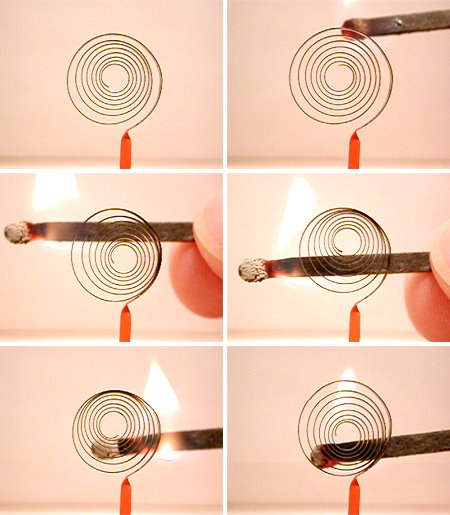
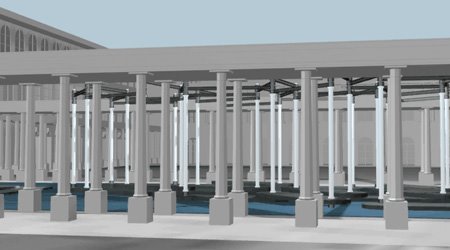
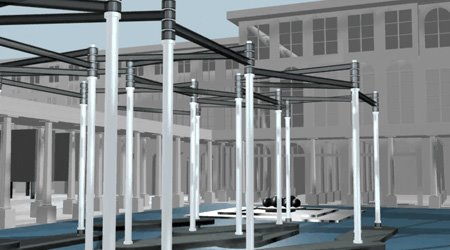
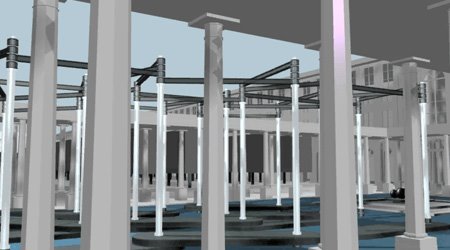
In anticipating e-tat's call for structures that are indiscriminately responsive to geophysical stimuli and suffer no structural failure afterwards, David L. Hays proposed a program which “exploits an aspect of structural design that has until now been actively repressed not so much by practical necessity as by a convention of thought in which the material truth of a building is considered secondary to a fixed image of its ideal form. A primary objective of my project is to neglect the singular ideal in favor of a notion of materiality enriched through understanding of natural dynamics (i.e., susception, transduction, and response). While the focus of such a pursuit might seem mundane or even banal, its implications for design are considerable and highly provocative. For example, sentient architecture replaces a rigid ideal of form with an elastic range open to radical transformation and even to deliberate systematic failure. That flexibility alone raises significant questions about how to situate and program a structure the formal states of which are linked to forces over which man has no control (i.e., those of climate). As a practice of design in which boundaries between art and technology are fully dissolved and in which form is both motivated and modified by shifting conditions of environment, sentient architecture conflates concepts of structure and environment that have hitherto been at odds, thereby allowing architecture and landscape to be theorized as a single discipline.”

Sentient Architecture

Sentient Architecture

Sentient Architecture


Sentient Architecture