Among the directives outlined in China's new five-year defense plan is the creation of a smart dust surveillance network. This will be comprised of speckle-sized devices that can sense environmental conditions, such as light, temperature and humidity. More importantly, they can gather civilian and military intelligence. Their tiny dimensions mean they are difficult to detect and can squeeze through the narrowest of gaps in doors and walls. They can communicate with each other wirelessly, as well as transmit data to a nearby command center or remote satellite.
Dust, already pervasive and a nuisance to allergy sufferers and the obsessive compulsive, will become even more intrusive, as invasive as sand in your crotch. They'll gather on tables and floors, collect in corners or in your hair, where they'll rest silently listening for aberrant civility. In such a domestic space relinquished to the state, dusting, vacuuming and other quotidian chores turn into political acts of subversion.
Meanwhile, for cross-border espionage, artificial weather stations in the Gobi Desert will churn and whirl up massive dust storms. It'll simply be a matter of turning on the spigot. Hit the switch, and the earth will reach out with vaporous tendrils. When these have nicely thickened, a liberal sprinkling of smart dusts will be added to create a heady stew, which in a day or two will paint vermillion skies over Beijing before crossing the seas and choking the cities of the Koreas, Japan and, much further afield, the Pacific coast of the United States.
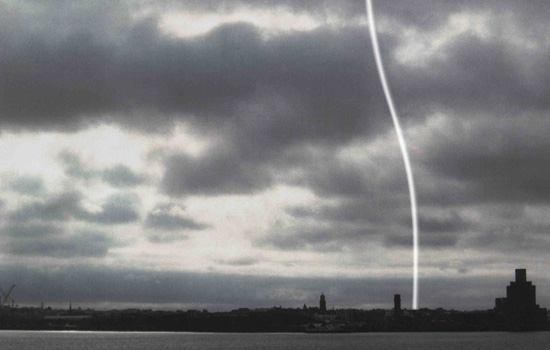
As part of the 2012 Cultural Olympiad, artist Anthony McCall will be spinning an artificial, mile high tornado in Liverpool. Called Column, this swirling micro-climate will be created “by gently rotating the water on the surface of the [River] Mersey and then adding heat which will make it lift into the air like a water spout or dust devil.”
Outside with the “[in]coherent convection” of the elements and without the controlled environment of some cavernousatriums, no doubt McCall and his engineering team will encounter some complications. But we're hoping the final piece will look as legible as the image, or at least on favorable days.
The eruption of Iceland's Eyjafjallajökull volcano has surprisingly led us to wonder about the prevalence of conflict flowers, those perishable symbols of beauty and romance cultivated under economic inequity and environmental exploitation.
“Farmers in Kenya are dumping tonnes of vegetables and flowers destined for the UK, four days after the volcanic ash cloud over Europe grounded cargo shipments from Africa,” reportsThe Guardian.
Kenya's flower council says the country is haemorrhaging $1.3m a day in lost shipments to Europe. Kenya normally exports up to 500 tonnes of flowers daily – 97% of which is delivered to Europe. Horticulture earned Kenya 71 billion shillings (£594m) in 2009 and is the country's top foreign exchange earner.
The flower trade may have brought much needed investment to the country, but it has also come at a cost. Like so many African countries, Kenya suffers from water scarcity, and flower farms have been blamed for exacerbating the problem through their intensive use of irrigation and pesticides. The use of chemicals has further added to the already poor working conditions. Women are discriminated, child labour is weakly discouraged, and all are paid with unfair wages.
Maybe conditions are less exploitative than how they appear to us from our distant and limited vantage point, but one has still to consider the ethical implications of cultivating vast tracts of prime arable land to produce not foods and goods for the local population but for the gas-guzzling export of what essentially amounts to lazy sentiments commodified by a multibillion dollar global guilt industry.
Perhaps for Mother's Day next month, we'll try to wean ourselves off our addiction to flower porn.
Thanks to Iceland's volcanic ash cloud, we're again obsessed with vapor — clouds, mists, fogs, steam, chemical gas warfare, the miasma theory of disease — in fact, with just about any aerosolized matter like sandstorms, carcinogenic dust clouds of asbestos, crowd control tear gas, climate change smog and forests atomized through slash and burning. One could devote an entire blog just on this topic alone without running out of material, as anything could probably be vaporized, given a couple of thermonuclear bombs or a supernova or some apparition lessons at Hogwarts.
If one were indeed to start such a blog (perhaps called Pathological Aerology in imitation of the awesome Pathological Geomorphology), there definitely should be an entry on Juliet Haysom's Spring.
The proposal of which having won the Jerwood Sculpture Prize in 2007, Spring was permanently installed the following year at Ragley Hall, a stately country house near Stratford-upon-Avon in England.
Quoting Haysom:
Researching my proposal for the Jerwood Sculpture Prize brief, I realized that Ragley Hall is situated above one of England's most significant aquifers. About 40 percent of Severn and Trent Water's supply comes from this vast subterranean water resource, as do the celebrated springs at nearby Malvern, Leamington Spa and Burton on Trent.
Rather than construct and import something into the park, my proposal involved drilling a borehole into the aquifer below the site. Water from the borehole would be then pumped to the surface where it would appear as a cloud of fine mist. Spring's external form and appearance will vary significantly depending on weather and light conditions.
In other words, when early morning sunlight begins hitting the nearby solar panels that power the water pumps, the mist will slowly start to appear. At midday, the cloud will have expanded. When it's sunny, it will create a tower of mist, a sort of shimmering tree. If it's overcast or windy, however, its form will become tenuous, more spectral. If there's a rainstorm, then it will dissolve into the pouring rain.
As evening approaches and the light dims, Spring will dull down until vanishing completely for the night.
Quoting Haysom again:
While at first glance Spring might look like a natural phenomenon, on close inspection the form of its jets and the presence of nearby solar panels will reveal the fact that it is a man-made intervention into the landscape. The parkland at Ragley Hall is similarly deceptive; its rolling hills, informal stands of trees and picturesque lake were, in fact, designed by Capability Brown.
One of the towering figures of landscape architecture thus invoked, and along with him the monumentally rich history and traditions of garden design, it wouldn't be far off the mark to think Spring as a sort of avant-garde folly, a Greek temple vaporized and aerosolized against a sylvan backdrop to evoke the story of Jupiter and Io or the vaporous origins of the Centaurs.
Continuing a visual meme of late, above is a thick vermillion fog re-landscaping the city of Sydney anew. WritesThe Sydney Morning Herald, “Sydneysiders have woken to a red haze unlike anything seen before by residents or weather experts, as the sun struggles to pierce a thick blanket of dust cloaking the city this morning.”
The photograph is just one of hundreds documenting this freak meteorological event. No doubt there will be thousands, perhaps hundreds of thousands, taken before the last grain of sand settles down. And as these images find their way into each and every blog in the universe, alighting twitter, Facebook and forums, and yes, even as they infiltrate the local evening news, the water cooler and the rest of old media, it's worth quoting again from Diller + Scofidio's Blur: The Making of Nothing.
When we speak about weather, it's assumed that more meaningful forms of communication are being avoided. But is not the weather, in fact, a potent topic of cultural exchange - a bond that cuts through social distinction and economic class, that supersedes geological borders? Is not the weather the only truly tangible and meaningful thread that glues us all together? Is not the weather the only truly global issue? In truth, contemporary culture is addicted to weather information. We watch, read, and listen to weather reports across every medium of communication, from conventional print to real-time satellite images and Web cams. The weather channel provides round-the-clock, real-time meteorological entertainment. Boredom is key. But boredom turns to melodrama when something out of the ordinary happens. Major weather events are structured like narrative dramas with anticipation heightened by detection and tracking, leading to the climax of real-time impact, capped by the aftermath of devastation or heroic survival.
Last year, the above photograph of the Tarim Desert Highway in western China was used to decorate a post in our now retired Prunings series. We've always thought that it should have its own separate post, so here it is.
As described by Wikipedia, the highway “crosses the Taklamakan desert from north to south. The highway links the cities of Luntai and Minfeng on the northern and southern edges of the Tarim basin. The total length of the highway is 552km; approximately 446km of the highway cross uninhabited areas covered by shifting sand dunes, making it the longest such highway in the world.”
“In 1994,” says People's Daily Online, “the Tarim desert highway was expanded to the central area of the Tarim Basin, and the completion of the central Tarim oil-gas field, the largest of its kind in China, will make Xinjiang become a strategic substitute area for China's oil and gas resources. Following this, the highway continued to expand in the desert and has turned into a macro-artery for bringing along the economic development in southern Xinjiang.”
In other words, it plays a key role in the country's energy security. And if we may be allowed to indulge ourselves for a moment and parse that last sentence, the highway is also an important tactical infrastructure of pacification through which state control, in the guise of “economic development,” can easier be meted throughout the mainly Muslim and violence-prone region.
To protect this supposedly strategic highway from getting buried by the encroaching sand dunes, rows of vegetation were planted on both sides of the road. An extensive irrigation network was laid down to sustain this artificial ecosystem, pumping water from underground reservoirs and then distributing it throughout. Although the water has a high saline content, this greenbelt has successfully taken root. The desert blooms.
While we cringe at reading that this greenbelt has somehow “improved” the ecology of the desert, it would be worthwhile to track down some of the research that were conducted in preparation for the project. We might, for instance, find out some new techniques that would help plants survive extended periods of drought. We're also interested in their plant list. Perhaps they have discovered that some species, previously not known for their hardiness, actually have a high tolerance for sandy soil and salty water, and then later, have genetically modified them to improve their survival rates. And who knows, maybe their experiments are paving the way for food crops, not just ornamental ones, to be cultivated in deserts and watered with sea water.
Considering that climate change will turn many places into deserts, these Tarim xeriscapers could offer us some helpful advice in adapting to our arid future.
And what's happening in the photo above? At first glance, we thought that they had covered the desert with hardscaping material, but on closer inspection, those are just rows of plants.
Still, we're hoping that someone will come along and leave a comment saying that for large sections of the highway where the vegetation cannot take root, the Chinese government had hired someone to pave over the dunes, a sculptor wanting to stop the migrating dunes dead on their tracks as a kind of long-form performance art. And then, due to several bouts of heatstroke and because that abrasive sand keeps getting into his crotch all the time, he just went out of control.
He's now concretizing the whole desert!
Meanwhile, notice the red-roofed blue buildings. According to National Geographic, they “appear every few miles [and] house workers who maintain the greenbelt.” The workers sign up for stints that may last up to two years. They may be with their spouses or get paired up with someone else, but essentially, they live solitary lives, an eccentric group of monastic botanists in a mystical struggle to arrest this ephemeral landscape in time and space.
One of the interesting things — and there are definitely many — that you will read about in Kazys Varnelis' paean to the “networked ecologies” of Los Angeles, The Infrastructural City, is the dust control system at Owens Lake.
After decades of monumental water projects that have diverted the lake's “life-giving liquid” to quench a distant city's thirsty populace, to ensure the perfect shade of green for their lawns, and to turn their swimming pools into aqueous micro-paradises, the now parched lake has become a health hazard.
Wind gusts above twenty miles an hour lifted over fifty tons per second of “Keeler Fog” off the lakebed. Often reaching over two miles high, these dust storms sent 130 times the United States Environmental Protection Agency's limit for particulate matter into the atmosphere, blowing the dust over 250 miles from the lake. Such storms occurred two dozens or more times each year, generally in the spring and fall. Composed of microscopic particles smaller than ten microns (PM10), the dust contains significant levels of toxic metals like selenium, arsenic, and lead along with efflorescent salts. The largest single source of PM10 pollution in the country, these dust storms were a clear threat to the 40,000 people in the immediate region.
The threat, according to Lehrman, came in the form of higher rates of cancer, respiratory disease, and eye problems.
To combat these carcinogenic storms, Los Angeles grafted onto the desiccated corpse of the lake a hydro-network as monumental as the existing network responsible for the situation it is tasked to offset: “over 300 miles of pipe (some as large as five feet in diameter), more than 5,000 irrigation bubblers, and hundreds of miles of fiber optic control cables and valves.”
[T]he dust control projects on Owens Lake is roughly equivalent to that of a waterworks for a city of over 220,000 people. Construction of the first five phases, treating the worst thirty square miles of dust-emitting soils on the playa, has cost the City of Los Angeles $425 million dollars to build. But that sum doesn't factor in the lost revenue from the water being appropriated for the project (around $15 million/year) or the operations and maintenance budget, some $10 million per year.
“[R]ising like alien plants on the terraformed lakebed,” the bubblers flood the playa with shallow water, creating the merest suggestion of a lake, a perverse reminder of Lake Owens' former self.
However superficial such observations may be, we couldn't help but see similarities between these bubblers and fountains.
Firstly, much like the fountains at Versailles, behind these water spouts is a staggering hydrological infrastructure. Among other things, Versailles had the Machine de Marley, considered the greatest engineering marvel of its time; Owens Lake is part of what is probably the greatest water engineering project of the 20th century.
Secondly, since time immemorial, fountains have been creating micro-climates, cooling gardens, palaces and sartorially bedecked aristocrats. The array of bubblers, you could say, is also a type of weather modification system: an anti-dust storm. Moreover, fountains like those at Columbus Circle in Manhattan can provide a sonic barrier, making one unaware of the tumult outside; with some conjecture, probably forced, you could say that the bubblers don't do much to make Los Angelenos more aware of the negative environmental effects their mode of living is contributing outside the city.
Thirdly, if one can only speculate that fountains have ameliorative effects on one's mental state, you probably don't need to speculate the positive health effects of the bubblers.
Fourthly, fountains like those in Rome are objects for aesthetic consumption; these ebullient and rather photogenic desert sprinklers, thanks to CLUI, have been appropriated into a staged aesthetic experience.
Lastly, and most significantly, they are the products of a complex network of intermingling social, technological, political, economic and geographical conditions, the manifestations of competing ideologies and agendas. They're not mere water features, in other words.
For the 50th anniversary of the International House of Japan in Roppongi in 2002, Takeshi Ishiguro “created a machine which pops out smoke rings automatically from a box which is placed in the large garden - every 5 minutes. The smoke shapes into a perfect circle first and gets transformed immediately depending on the wind etc. When there is no wind, it goes straight up to the sky keeping its shape until it finally disappears.”
You can watch the smoke rings in action on the artist's website.
And for more about the machine and Ishiguro's other works, you can read his interview with PingMag.
Meanwhile, what Takeshi Ishiguro should do next is construct more of these machines and place them all over Rome. Then on a cloudless and windless day, they will huff and puff away the complete text of Ovid's Metamorphoses — the epic poem translated into vapourous morse code.
At Piazza del Popolo, for instance, you will be able decipher the passage wherein Zeus turns himself into a cloud so that he could seduce the maiden Io without his eternally vengeful consort Hera detecting their tryst.
Elsewhere, at the more tranquil Giardino del Quirinale, you can read about how the Centaurs came into being from a curious coupling between King Ixion and Nephele, a cloud nymph who Zeus had created in the shape of Hera.
Everywhere churches, gardens and palazzos are wondrously oozing with smoke. The Eternal City seemingly dematerializing into air.
You wake up one morning in an unknown hotel in an unknown city. You try to remember, but their names have escaped you completely. The previous night's drunken revelry has fried up a bunch of short-term memory cells.
Sensing that a rare opportunity for some topographical experiment has just presented itself, you decide not to ask anyone where you are. Instead, you go out for a walk to find out for yourself, studying the native flora, indigenous architecture, and vernacular street patterns.
It's urban forensics! Or CSI: Landscape Architecture.
But unfortunately, there's this thick fog blanketing the entire city. It's hampering your terrestrial sleuthing. It's hard to see anything at all, let alone the street signs. There's a clearing now and then, but it's zero visibility most of the time.
Later on, you begin to notice that there's a pattern to the way the vaporous voids and non-voids pass you by. It's some sort of an encrypted message. You know this, because you were once in the Boy Scouts of America and had learnt from their field manuals how to interpret morse code and Native American smoke signals. You even earned a merit badge for it.
And so you go into the nearest park. You find a bench, sit, and get comfortable. Then you begin decoding.
After 13 hours of manic translating, fingers blistering, bloodied, whole hands cramping, you read what you've got written down:
its slow erosions of peninsulas and islands, its persistent formation of homothetic islands, peninsulas and downwardtending promontories: its alluvial deposits: its weight and volume and density: its imperturbability in lagoons and highland tarns: its gradation of colours in the torrid and temperate and frigid zones: its vehicular ramifications in continental lakecontained streams and confluent oceanflowing rivers with their tributaries and transoceanic currents, gulfstream, north and south equatorial courses: its violence in seaquakes, waterspouts, Artesian wells, eruptions, torrents, eddies, freshets, spates, groundswells, watersheds, waterpartings, geysers, cataracts, whirlpools, maelstroms, inundations, deluges, cloudbursts: its vast circumterrestrial ahorizontal curve: its secrecy in springs and latent humidity, revealed by rhabdomantic or hygrometric instruments and exemplified by the well by the hole in the wall at Ashtown gate, saturation of air, distillation of dew: the simplicity of its composition, two constituent parts of hydrogen with one constituent part of oxygen: its healing virtues: its buoyancy in the waters of the Dead Sea: its persevering penetrativeness in runnels, gullies, inadequate dams, leaks on shipboard: its properties for cleansing, quenching thirst and fire, nourishing vegetation: its infallibility as paradigm and paragon: its metamorphoses as vapour, mist, cloud, rain, sleet, snow, hail: its strength in rigid hydrants: its variety of forms in loughs and bays and gulfs and bights and guts and lagoons and atolls and archipelagos and sounds and fjords and minches and tidal estuaries and arms of sea: its solidity in glaciers, icebergs, icefloes: its docility in working hydraulic millwheels, turbines, dynamos, electric power stations, bleachworks, tanneries, scutchmills: its utility in canals, rivers, if navigable, floating and graving docks: its potentiality derivable from harnessed tides or watercourses falling from level to level: its submarine fauna and flora (anacoustic, photophobe), numerically, if not literally, the inhabitants of the globe: its ubiquity as constituting 90 percent of the human body: the noxiousness of its effluvia in lacustrine marshes, pestilential fens, faded flowerwater, stagnant pools in the waning moon
Lo! You're in Dublin!
Today is Bloomsday!
And there are 13,000 Takeshi Ishiguro machines installed throughout the city belching out James Joyce's Ulysses. Unabridged.
No, Al-Qaeda has not mastered the trigonometric art of granular blitzkrieg. Simply it's the Earth-Fountain undergoing some preliminary tests in Iraq to resolve some mechanical kinks before its delivery to yet another outrageously themed megapark in Dubai.
In the meantime, go here for more ridiculous sand storm photos. We do not know who the photographer is, but please, anyone, let us know. The same person presumably took these amazing photos of ordnance disposal as well.
Meanwhile, how about designing a landscape where the earth is truly destabilized, temperamental. Where the ground plane is not treated as an immovable canvas whereupon trees and paths and benches are simply thrown in. After all, we stand on a surface that shifts and glides everywhere, all the time.
So you're strolling down the beach one afternoon — walking the dog, if you will. That night the 67th hurricane of the season comes along and plows through your oceanfront enclave. You think everything has been destroyed. But the morning after, you find that you can still walk your dog along the same path, on that same boardwalk. It may have migrated half of a mile and is now oddly reconfigured, but it's still functional nevertheless.
Or a levee system that meanders with the river. End the tyranny of cement and the Army Corps of Hubris for all time.