
Showing posts with label art_installations. Show all posts
Showing posts with label art_installations. Show all posts
Double Positive

We have not come here for a rendezvous.

We have come here simply to rest.

We are refugees, en route to less troubled terrains with only a thin film protecting our caravel from the fallout. Thinking this ancient swimming pool a safe harbor, we berthed our diaphanous spaceships within its partitioned terminal.

Our stay will be brief, but the vaseline landscape might just convince us to strike our Utopia here.
Natural Car Alarms

A comment left on our post on Australia's lyrebirds pointed us to the work of Nina Katchadourian, specifically Natural Car Alarms, a piece which was installed in 2002 at several locations around New York.
For the exhibit, the Brooklyn-based artist hacked the alarms of three cars to emit not the natural soundtrack of the city but the sonic pattern of real birds. This urban automotive flock, in other words, was “re-edited” into counter-lyrebirds.

Katchadourian writes: “Almost as important as matching the sounds was finding a patterning that mimicked the swooping cries and punctuated honks of the familiar six-tone siren. They also needed to be as loud, intrusive, obnoxious and surprising as the real thing. Ideally, I wanted to replicate some of the ambiguity I had experienced in the forest, where the urban and the natural were suddenly very continuous. Car alarms were after all a completely natural part of the Long Island City landscape where the piece would be shown.”
It's worth pointing out that one of the mimicked birds is actually a Superb Lyrebird. This copying of a copier could have set out the marvelous scenario, in which a lyrebird, upon hearing its own song converted into a car alarm, proceeded to mimic its reprocessed mating call. And then Katchadourian comes along again intent on making another remix.



Liverpool Tornado
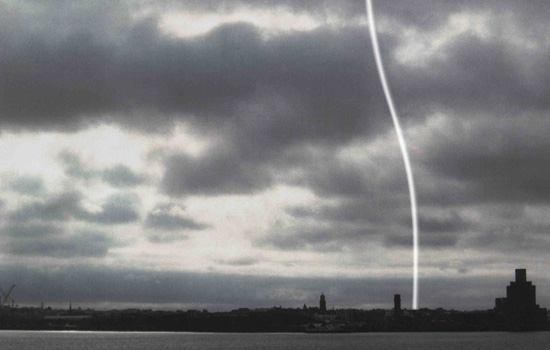
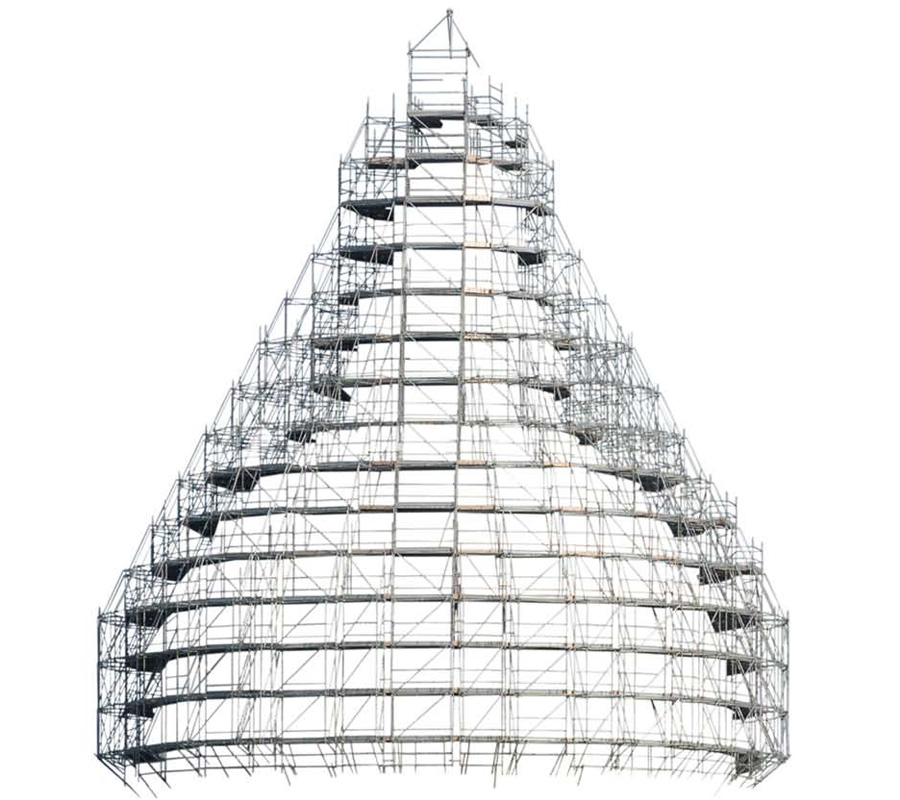
As part of the 2012 Cultural Olympiad, artist Anthony McCall will be spinning an artificial, mile high tornado in Liverpool. Called Column, this swirling micro-climate will be created “by gently rotating the water on the surface of the [River] Mersey and then adding heat which will make it lift into the air like a water spout or dust devil.”
Outside with the “[in]coherent convection” of the elements and without the controlled environment of some cavernous atriums, no doubt McCall and his engineering team will encounter some complications. But we're hoping the final piece will look as legible as the image, or at least on favorable days.
Deep Space Public Lighting, Chilean Copper-Gold Mines, Rare Earths Geopolitics, and iPhones as Portable Artificial Suns

For the past few months, I-Weather.org, developed by Philippe Rahm and fabric | ch, has been churning up a pastel maelstrom here on this blog for use by our spatially and temporally displaced readers to restore their circadian rhythms, whether this is actually possible or not. You, too, can embed this artificial sun on your website to blast your asynchronous readers into metabolic normality. Its open source code is freely available.
At the recent 01SJ Biennial in San Jose, California, we saw a less earthbound and less private platform for this quasi-light therapy: a flickering light tower for “confined and conditioned environments of space exploration vehicles” and “speculative public spaces of distant colonies.”
To distribute and synchronize these pockets of simulant terrestrial cycles of day and night across vast distances, fabrica | ch proposes using a theoretical Deep Space Internet.


By happy coincide, we first learned about this project just as the first reports about the trapped miners in Chile started trickling in to our attention, specifically, the news that NASA scientists have been flown in by the Chilean government to offer advice on how to help the men stay physically and mentally healthy during the weeks-long rescue.

Al Holland, a NASA psychologist, says during a press conference:
One of the things that's being recommended is that there be one place, a community area, which is always lighted. And then you have a second area which is always dark for sleep, and then you have a third area which is work, doing the mining, and the shifts can migrate through these geographic locations within the mine and, in that way, regulate the daylight cycle of the shift.
It occurred to us that one should make a portable version of Deep Space Public Lighting for future mining disasters. It should be able to fit through bore holes and then easily assembled by survivors in the murky depths of a collapsed tunnel.
A deployable piazza for subterranean “distant colonies.”

Rather than being illuminated by the anemic brightness of a hard hat or video camera, one bathes in soothing electromagnetic wavelengths from a technicolor torch.
Or from an i-weatherized iPhone.

And yes, considering the high demand for coal and industrial minerals, there will be many more mining disasters, many more trapped miners and, depending on various fortunate circumstances, more tunnels to be reconfigured. In fact, only a few days after the last Chilean miner was brought to the surface, 11 miners were trapped at a coal mine in China after a deadly explosion.
Consider, too, the recent export ban by China on shipment of rare earth elements to Japan after a kerfuffle between the two countries involving a collision between a Chinese fishing trawler and Japanese Coast Guard patrol boats near some disputed islands. The ban may have been brief, and China may have denied having instituted one in the first place, nevertheless, the incident points again that China is willing to use its near resource monopoly of rare earth metals as a political tool, to get its way, in other words. Other countries have again taken notice, and are scrambling to develop alternative sources, if not already, to ensure future supply. With new mines opening and even old mine operations being restarted, there are more potentials for disasters.
Reformatted in this context, Deep (Inner) Space Public Lighting engages not just with issues such as “public space, public data, public technology and artificial climate” but also with the geopolitics of natural resources, globalization and our collective networked boredom that seemingly can only be satiated by an epic spectacle of natural and man-made disasters and the ensuing heroic rescue of survivors.
To Io

Thanks to Iceland's volcanic ash cloud, we're again obsessed with vapor — clouds, mists, fogs, steam, chemical gas warfare, the miasma theory of disease — in fact, with just about any aerosolized matter like sandstorms, carcinogenic dust clouds of asbestos, crowd control tear gas, climate change smog and forests atomized through slash and burning. One could devote an entire blog just on this topic alone without running out of material, as anything could probably be vaporized, given a couple of thermonuclear bombs or a supernova or some apparition lessons at Hogwarts.
If one were indeed to start such a blog (perhaps called Pathological Aerology in imitation of the awesome Pathological Geomorphology), there definitely should be an entry on Juliet Haysom's Spring.

The proposal of which having won the Jerwood Sculpture Prize in 2007, Spring was permanently installed the following year at Ragley Hall, a stately country house near Stratford-upon-Avon in England.
Quoting Haysom:
Researching my proposal for the Jerwood Sculpture Prize brief, I realized that Ragley Hall is situated above one of England's most significant aquifers. About 40 percent of Severn and Trent Water's supply comes from this vast subterranean water resource, as do the celebrated springs at nearby Malvern, Leamington Spa and Burton on Trent.
Rather than construct and import something into the park, my proposal involved drilling a borehole into the aquifer below the site. Water from the borehole would be then pumped to the surface where it would appear as a cloud of fine mist. Spring's external form and appearance will vary significantly depending on weather and light conditions.
In other words, when early morning sunlight begins hitting the nearby solar panels that power the water pumps, the mist will slowly start to appear. At midday, the cloud will have expanded. When it's sunny, it will create a tower of mist, a sort of shimmering tree. If it's overcast or windy, however, its form will become tenuous, more spectral. If there's a rainstorm, then it will dissolve into the pouring rain.
As evening approaches and the light dims, Spring will dull down until vanishing completely for the night.


Quoting Haysom again:
While at first glance Spring might look like a natural phenomenon, on close inspection the form of its jets and the presence of nearby solar panels will reveal the fact that it is a man-made intervention into the landscape. The parkland at Ragley Hall is similarly deceptive; its rolling hills, informal stands of trees and picturesque lake were, in fact, designed by Capability Brown.
One of the towering figures of landscape architecture thus invoked, and along with him the monumentally rich history and traditions of garden design, it wouldn't be far off the mark to think Spring as a sort of avant-garde folly, a Greek temple vaporized and aerosolized against a sylvan backdrop to evoke the story of Jupiter and Io or the vaporous origins of the Centaurs.

On fountains
Site Specific

UK landscape artist Kane Cunningham is planning to rig his new home with cameras not to film the stunning views of the North Yorkshire coast but to document its imminent destruction. Sitting precipitously close to the edge of a cliff, the house could fall off at any moment. Coastal erosion has already eaten away most of the garden.
Some nearby houses were similarly threatened but were condemned and demolished in advance of the migrating cliff edge. Cunningham, however, wants the climate-changed sea itself to devour his bungalow.
Interestingly, Cunningham bought the house, worth £150,000 two years ago, for just £3,000 on his credit card, “a deliberate financial transaction suggesting the link to credit, subprime mortgages, property ownership, debt, loans, the financial markets, property speculation, boom and bust.”
“It’s global recession and global warming encapsulated,” adds the artist.
POSTSCRIPT #1: In March, the BBC reported that Kane Cunningham has changed his plans. He'll demolish the house rather than let it fall off the cliff.
Operation Beachhead
Climate Ghettos
Sand Wars
The Retreating Village
“This is Botanydome. Death is listening, and will take the first plant that screams.”

Natural Selection by Tim Simpson, now of Studio Lithero, is “an instrument that competes plants against each other. The device empowers plants to control the fate of others using sensors and mechanised shears in a Darwinian race for survival. The sensors set above the plants detect the first to grow to a specified height, at which point it is saved, and the others fatally chopped.”
One wishes this was marketed for the home decorating market, perhaps through a partnership with Martha Stewart Living Omnipedia or Home Depot; a mass produced kinetic sculpture that approximates the violence and savagery of nature, the brutal facts from which indoor plants seem happily divorced, that is, if they're lucky enough to have attentive owners.
You can take bets from your houseguests on which one will win the race, and everyone can check the status of the race on Twitter. The victor will tweet, “I RULEZ!” The losers, “PWNED.”
In any case, be sure to watch this video of an actual race.
Vectorial Vancouver

For the month of February, including the two weeks when the 2010 Winter Olympic Games will be staged, you can participate in the fifth and latest installation of Rafael Lozano-Hemmer's Vectorial Elevation in Vancouver.
Twenty robotic searchlights have been spread out along the English Bay, and via a three-dimensional interface on the installation's website, their positions can be reconfigured by anyone. From anywhere in the world, you can redesign the skyline of Vancouver.
You can render the intricate vaulting system of a Gothic cathedral or the geometric tessellation of a Persian mosque; inscribe cryptic constellations onto passing clouds; or cultivate a photonic bouquet for Valentine's Day.
Perhaps someone might want to recreate a childhood memory of searchlights that once beckoned them to a glamorous Hollywood movie premier while another might one to evoke the torched nighttime skies of London during the Blitz. Indeed, searchlights add spectacle and a sense of excitement to any event, thus making them perfect additions to the festive environment of the Olympics. But they are also harbingers of violence and destruction, and of course, the Olympics have a long urbicidal track record.
In any case, all designs will be placed on queue, then projected for everyone to see on site or on webcams, and finally given their own webpage with photographs as documentation of your participation.
Bodies in Motion, Bodies at Rest
Great Street Games

Speaking of augmented game spaces, here is an interesting interactive installation set to come online at the of the month in three UK cities. Created by KMA, Great Street Games will be a “huge, participatory, high-tech athletics tournament” in which participants in Gateshead, Sunderland and Middlesbrough compete against each other virtually in real-time using the city as platform.
KMA will use projected light and thermal-imaging technology to create interactive 'courts' in which human movement triggers light effects. The physical movements of players determine the outcome the games, which will run on ten-minute cycles. Participants develop their game-playing skills as they progress through a number of levels to help their area to victory or to simply have fun.
The parameters of this urban sport are described thus:
The ‘courts’ created by projected light; each court comprising a central playing area and two zones representing the other two locations. Balls of light appear from the centre of each court – these projected images can be moved by players physically ‘touching’ them. The aim of the first game is for each location to gain points by moving as many balls as possible to the other locations. Games last 90 seconds and 5 games make a series – through which the games increase in complexity as players become more familiar with the rules. The town or city with the most points at the end wins.
It reminds one of the telepresent urban spaces of Rafael Lozano-Hemmer.

You're walking home alone one night through pedestrian unfriendly, darkly lit corridors. All of a sudden, you trigger a sensor and projectors spray the pavement with technicolor lights. Ebullient geometries seemingly float above the asphalt.
“Wanna play,” a disembodied voice rings out from a speaker.
“Umm, sure,” you instinctively respond, even if you don't how to play what is to be played. “I'll learn along the way,” you say to yourself.
And then it's hours later; the sun is about to rise and wash out the lights. The two of you promise to return the following night (tonight, actually) to continue the game, with friends to make it a team competition. It'll be Chicago vs. Manchester.
“Is this some sort of a next generation MMORPG game?” you wonder.
A week or two later, you find out on Twitter that there are other similar game spaces installed throughout the city, but their locations are a secret. There's no iPhone app for it yet. So you set on a walkabout, hoping that you might again trigger a sensor.
Public Water Purification Island

Here's an art installation from Synchronicity, an architecture/arts festival in Warsaw, Poland. Conceived by Jakub Szczęsny as a member of the design collective Centrala, it consists of a floating island fitted with exercise machines. When the machines are being used, water gets pumped from the polluted Vistula River to a filtration device located overhead at the center of the platform. The water is intended to be potable at the end of its purification cycle, ready for use by thirsty festivalgoers.


According to Szczęsny: “The whole installation is supposed to perform a role of a propaganda tool changing the consciousness of Warsawers by showing the efficiency of human action in the process of purifying the waters of their river. What’s meaningful is the fact that many Poles, even after twenty years of liberalization, still don’t believe in their own potential as individuals or members of communities, in positively changing their environment.”

Could Szczęsny also be presenting us an alternative to the much maligned bottled water? One could set up a stringed necklace of these water islands on a river, say, the Thames, or along a waterfront, say, Chicago's Lakefront, besides trails frequented by joggers, bikers and marathoners in training who, as a communal activity (a civic responsibility, in fact), keep the tanks full for use by themselves and the marginally active.
The Hydrological Playground


Transgenic Storms

We're paying a return visit to the Center for PostNatural History, this time for Permitted Habitats, their infographic on genetically modified organisms allowed by the U.S. Department of Agriculture for field tests since 1987. This map shows where these neo-florae have been released into the environment, which institutions have applied for the permits to conduct the experiments, and what enhancements these organisms have been engineered with, for instance, drought tolerance and fungal resistance.
Having taken many joyrides over the years throughout Illinois, which according to the map has hosted many of these real world trials, we may have driven past by one or two of these plots. But we wouldn't know. Some protocols may have been set up so that no rogue environmentalists will come and uproot the plants, say, electrified fences or surveillance sensors, but perhaps the best form of quarantine is anonymity and apparent ordinariness. One passes by them oblivious, because they are as unremarkable as the next hundreds of thousands of rows of corns. But of course they're not. To once again borrow from Trevor Paglen, these are genomic dark spots in the landscape, fully alight with the Midwestern sun.

One of the things we like about this map is how the icons pop in and out, sometimes massing together and swelling to shroud an entire state before desiccating gradually. Quiet passages of solitary icons here and there, then a massive pileup; transgenic thunderstorms developing over some skies somewhere, possibly flooding an uncontaminated gene pool with a deluge of foreign DNAs. It's like watching the time-lapsed maps of The Weather Channel.

Or the as yet uncommissioned The Transgenic Weather Channel. Instead of actual meteorological events, it will track these genetic fringes, these dark topographies shrouded in secrecy by Big Agro, Big Pharma and their patent lawyers, for any signs of quarantine breaches. When something jumps over the fence, periodic bulletins will be issued.
High 70s. Clear in the a.m. Thick fog of insulin pollen in the p.m.
Sirens will blast across the whole county.

A Zoo in Vienna

Schönbrunn Zoo in Vienna is host to a fascinating series of temporary art installations by Christoph Steinbrener and Rainer Dempf. In one animal enclosure, the German duo have half-submerged a car in a watering hole used by the resident rhinos. In another enclosure, penguins frolic in the shadow of an oil pump, and in yet another, alligators must share their modest bayou with a bathtub and a monster truck tire.
According to the artists, these scenes of ecological nightmares are “experimental set-up[s]” in which “the viewer is forced to reconsider traditional modes of animal presentation and simultaneously to question the authenticity of concepts which are restaging 'natural' environments while they are increasingly endangered.”

Quoting further: “Present-day conceptions of zoological gardens aim at the presentation of animals in an idyllic and apparently natural environment, untouched by civilization. But this is a contemporary conception, since courtly menageries and kennels were adapted to the exposure of animals as decorative objects. Until the early years of the 20th century, animals were part of a preferably spectacular and exotic staging, to the entertainment and amazement of the public. The artificial and the sensational were foregrounded, without creating a realistic setting of the natural environment of the animals.”


The installations will last until October 18, 2009.
Other Simulated Worlds

Subscribe to:
Posts (Atom)