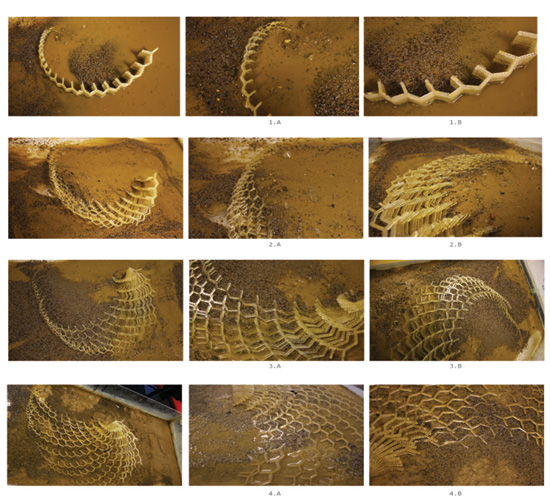
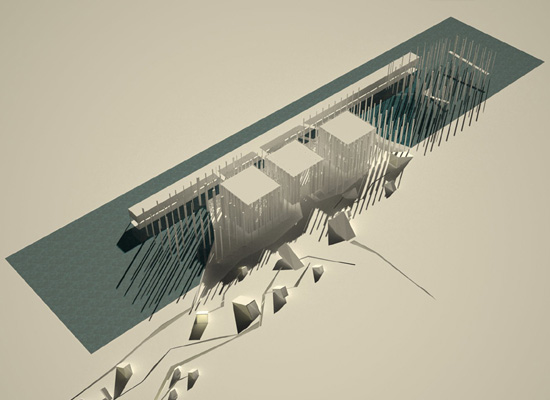
We continue our time-saving survey of projects situated on that ambiguous line separating land and water with Fabrizio Matillana's Marsh Condenser, one of the ecoMachines coming out of Claudia Pasquero and Marco Poletto's studio at the AA.
Matillana describes his ecoMachine as “an evolutionary infrastructure situated in the Essex estuary, restoring lost marshland ecologies through a park typology based on sediment collecting ‘folies’ [sic] bridging the dynamic flood cycles of the site and the public that visit the natural reserve.”
These follies act “as a combination of hard and soft engineering technique to increase accretion levels within the test site which is necessary to stabilize marshland in risk. Soft engineering in the sense that it is highly sensitive to its positioning in relation to the environmental dynamics and stresses that contribute to the preservation or destruction of a marshland ecology. Hard engineering in its material presence acting as ‘sediment corset’ and allowing an architectural intervention that embeds itself within the emerging ecology.”
In March, Circle of Bluereported that the Shimo la Tewa prison near Mombasa, Kenya, is to replace its broken sanitation infrastructure with an artificial wetland to clean its wastewater. Funded in part by the United Nations Environmental Program (UNEP), it is the first project of its kind in Kenya.
Shimo la Tewa’s new system uses gravity to pipe waste water 200 meters away from the main prison buildings to a screen that traps the solid waste. The remaining effluent enters a septic tank to break down anaerobically before it flows through the wetland, which is filled with plants that naturally filter pollutants, such as water hyacinth.
When the wetland is completed in April 2010 it will provide the added benefit of recycled water that the prison can put to economic use. Shimo la Tewa will install aquaculture ponds that will create work for prisoners at a neighboring minimum security facility, [Shimo la Tewa's Senior Sargeant Paul Cheruiyot] said. Any excess water will irrigate plants on the prison grounds.
As estimated by UNEP, “operating and maintenance costs for the constructed wetland are roughly $50 per person served, compared to $300-$500 per person for the pumped systems.”
Though mindful of the ethical implications of using inmates as guinea pigs, we're nonetheless tempted to think that prisons are, or most likely have always been, ideal testing grounds in which to form and develop new and alternative systems to redress conditions of resource scarcity. It's not shockingly revelatory to say that these carceral spaces are really miniature cities or the whole world condensed, continually concerned with issues of food, health and shelter. Increasingly burdened with over carrying capacity and diminishing financial inputs, they're on a perpetual crisis mode, a disaster in waiting, just like the world outside their walls. One could thus understandably assume that such threat of catastrophe would turn a prison into a hotbed of innovations.
Continuing an occasional series on our formative design influences, this is Elevated Wetlands, a public art project in Toronto, Canada, by landLAB's principal landscape architect Neil Hadley and artist Noel Harding. Long time readers no doubt have noticed our obsession with constructed wetlands. This is the root cause, the epidemiological vector.
Installed more than a decade ago, the project consists of six large polystyrene containers that are filled with recycled plastics acting as large hydroponics planters for native plantings from the Don River Valley. Water from the polluted Don River is pumped via solar photovoltaic pumps into the sculpture, and is filtered through the planted containers, and then cascades into large ground level wetlands, returning to the river cleansed.
While the water that re-enters the river is significantly purified, the impact of these elevated wetlands in improving environmental quality is negligible at best. The water they process is too small. However, as a teaching tool on ecological and design issues, their impact may be far greater. In our case, it was profound.
Elevated Wetlands taught us the remediating properties of wetlands and that these natural processes can be artificially recreated. Wetlands are the kidneys of the environment, we learned with further investigation, and like in some eco-utopian fantasia, these organs can be cloned without bodies — a modular cyborg landscape.
Prominently sited as they are next to a major traffic artery into downtown Toronto, it was one of our very first lessons in context, something drilled into us during the heady days of Year One and forever after. And it was also an early introduction to the concepts of “revelatory landscapes” (i.e., making the invisible visible) and “working landscapes” (as opposed to landscapes of leisure and meditation).
And this project even taught us that there needn't be a conflict between ecology and aesthetics, that in trying to reclaim degraded landscapes, the science and the technology that do all the heavy lifting can be incorporated into a work of art that isn't superficial but one that can actually be provocative.
Now, a decade later, or post-High Line, how about finding disused elevated train tracks and converting them into linear wetland to treat urban stormwater and wastewater?
A ribbony infrastructure coiling and recoiling around the city, spiraling around tower blocks and zigzagging down skyscrapers; an eco-progeny of Brutalist skyways, skybridges and skywalks.
Israel is in the midst of a water crisis. Climate change, a rapidly growing population, extensive agriculture and a very developed industry are all putting pressure on the few and extremely contested sources of freshwater.
Desalination creates more problems than it solves, because the process is energy intensive, expensive, and besides freshwater, ironically produces highly toxic byproducts as well. Though not as egregiously unsustainable, wastewater treatment plants function under a similar ecological imbalance. More efficient and creative ways to offset water demand are therefore needed.
Ayala is an Israeli company which specializes in designing and building artificial wetlands to treat contaminated water from agriculture, industries and urban areas. The treated water will definitely not be potable, but at least it could still be re-entered into the system and be used in some way again, thus reducing the need to extract more from already dwindling supplies. And if it isn't reused and instead gets dumped immediately, at least the effluent will not pollute these precious supplies much.
We have described the principle of these eco-machines before in numerous posts, but to repeat, they take advantage of the ability of certain water plants not only to extract pollutants from the soil and water but also to render them inert. With the help of microorganisms, such as microbes, bacteria and fungi, they can take in toxins, heavy metals, greasy substances and pathogen agents. They can even phytoaccumulate and phytoremediate, to use the technical terms, substances that more technologically advanced systems cannot.
Of course, no single species can neutralize all contaminants. There isn't even a master matrix of plants and microorganism that works in every scenario. The trick is in finding the right combination that, in a sustainable manner, most efficiently removes the target pollutant and yields the purity level one is aiming for.
Ayala has been doing just that for nearly two decades and has deployed their wetlands machines all over Israel and in other places further afield. You can find them in domestic settings treating household sewage so that the reclaimed water can be used for irrigating the garden. Higher up on the urban scale, they can be found treating municipal wastewater and also the stronger stuff, the poisonous waste, from industrial sites. The company has also been involved in projects to treat landfill leachates and to rehabilitate degraded rivers.
Of course, Ayala isn't the only company applying ecological solutions to wastewater treatment. There's John Todd Ecological Design, possibly the most popular of them all, or at least the one with the most media coverage; Natural Systems International, who co-designed Sidwell's educational wetland; and Worrell Water Technologies, who holds, to our surprise when we first learned of it, the registered trademark for Living Machine®. It's a crowded field, thankfully.
But who besides Ayala is also working on contested terrain? Who could also say that their artificial wetlands have a geopolitical dimension to them? We're not saying that Ayala's eco-machines are co-conspirators, but who else could possibly say that theirs might be helping to entrench settlement of lands with varying narratives of provenance, with conflicting claims of true ownership? Who else is potentially employing Nature, albeit a Frankenstein version of it, as an instrument of occupation and hegemony, of erasure and amnesia? Who else could be, just maybe, quite possibly, after the deepest parts of our spatialist hearts?
Reading an ASLA interview of Jose Alminana, a principal at Andropogon Associates, we were reminded that Sidwell Friends School, the Quaker school of choice for the Obamas, the Clintons, the Gores, the Bidens, the Nixons — practically every member of Washington's politocracy, except for the Carters, of course — has in the courtyard of a recently renovated building an artificial wetland.
Not merely an eco-ornament, it's a machine that “manages all the wastewater generated by the building, as well as all the rain water that falls on the site.”
Typically, wastewater is drained away via a complex network of tunnels that requires vast financial resources just for its maintenance, an infrastructure that's undoubtedly deteriorating just as fast as tax revenues get siphoned off away from public works budgets to General Motors and Bank of America. Miles and miles away from its point of origin, the water then gets treated in an energy intensive process. But it still isn't entirely clean afterwards. Thus, when discharged, it still poses a risk to bodies of water, contributing in many instances to elevated bacterial count and eutrophication.
At Sidwell, wastewater is treated on-site, somewhat off-the-grid and using comparatively minimal infrastructure. The treatment cycle begins inside the building in a tank filled with anaerobic bacteria. Among other things, these bacteria help break down solids. The effluent is then pumped outside to a trickle filter before continuing on by gravity to a series of tiered wetlands. To lessen the health risk of contact with students and to mitigate any odor problems, water flows through beneath layers of pea gravel; there's no surface flow, in other words. This planting medium contains phytoremediating plants which, together with the microorganisms attached to their root hairs and to the gravel stones, extract contaminants from the water. After slowly trickling its way outside for about a couple of days or so, the water then re-enters the building and gets collected in storage tanks as greywater ready for reuse, for instance, to flush toilets.
Just as with wastewater, managing urban stormwater typically involves massive infrastructure to dispose runoffs as efficiently and as quickly as possible. In addition to being a drain on municipal coffers, such a method is known to increase the probability and the intensity of a flood event during major storms, endangering human life and property. Moreover, since stormwater isn't allowed to remain where it falls, (1) water doesn't have enough time to infiltrate the soil and seep into waiting, possibly depleted groundwater aquifers, and (2) what may have been clean at first contact with the surface undoubtedly will not remain so as it moves through sidewalks, roads, parking lots and sewers before going on to pollute rivers, lakes and other sources of our drinking water.
At Sidwell, we get a hint of an alternative system for stormwater management: hyperlocal, lo-fi, modular (i.e., implementations at multiple sites would be needed to bring about an appreciable effect on urban hydrology), soft and comparatively cheap.
Runoff is directed to a rain garden and a permanent biology pond located downslope from the tiered wetlands used for wastewater treatment.
Some of the runoff gets in an underground cistern. During dry weather, this storage tank provides water to the pond. During heavy rains, excess water flows from the pond into the rain garden, simulating the hydrological dynamics of a floodplain environment. Water seeps through the soil and gets naturally filtered.
Andropogon describes this project as a “working landscape” but we might prefer calling it an “event landscape,” wherein natural processes are co-opted into a cybernetic amalgam of landscape, architecture, geology, biology and institutional pedagogy. Rather than in the inaccessible subterranean voids and in scientific abstractions, this eco-machine is made to perform out in the open for the edification of the elite who, in their dirty, smelly, real-world engagement with the landscape, will hopefully turn into great stewards of the earth.
1) Wetlands are “the kidneys of the landscape,” able to filter out pollutants from, for instance, agricultural runoffs and urban effluents.
2) Because of their bioremediating properties, wetlands can be a cheap alternative to municipal waste water treatment.
3) During particularly heavy storm events, they act as temporary water storage tanks. They then release the excess water slowly rather than in a deluge, lowering flood heights and minimizing the damage of valuable property downstream.
4) Wetlands also store carbon within their live and preserved (peat) plant biomass instead of releasing it to the atmosphere as carbon dioxide. Therefore, wetlands world-wide help to moderate global climate change.
5) Along the coast, they are good at mitigating the effects of hurricane storm surges, tsunamis, and the less energetic but no less destructive normal ebb and flow of ocean waves.
6) Wetlands help to replenish aquifers that so many people depend on.
7) They are “biological supermarkets,” producing annual commercial harvests of fish and shellfish that sometimes amount to hundreds of millions of dollars. Indeed, many people rely on wetlands for their livelihood.
8) As eco-attractions, they inject a sizable amount of tourist income to the local economy.
Wetlands, in other words, provide so many beneficial services for people that they are very much deserving of a sacrificial virgin. Or two.
Meanwhile, apart from their more tangible benefits, wetlands have always been a source of intellectual fascination for us. According to Rodney Giblett in his book, Postmodern Wetlands: Culture, History, Ecology, only recently have people come to see them as very important features in the landscape. Especially “in the west,” they were long seen as “places of darkness, disease and death, horror and the uncanny, melancholy and the monstrous.”
Dante and Milton demonized them, calling them the embodiment of sin and impurity, the darkest expression of a corrupted inner self. Popular culture in later eras has populated their murky depths with the Swamp Monster, the Creature from the Black Lagoon, murderers and pederasts, satanic occultists and incestuous cousins.
Empires and fledgling nations everywhere simply thought of them as a wasteland, an obstacle towards their Manifest Destiny. So they were drained, cleared of vegetation and filled in. Suffocating them out of their own hydrology was a cause célèbre, indeed considered a heroic act, because to destroy wetlands was to be civilized.
Now with greater scientific understanding of their environmental functions, wetlands are undergoing a sort of cultural reconstruction. In a reversal of fortune that landscape scholars must surely find interesting at the very least, they are metamorphosizing from an anti-Eden into an ecological paradise.
Flooding the recently closed Tempelhof Airport would open up a catalogue of new opportunities for the city, not least a vast beach with what would become the largest beach hut on earth forming a grand backdrop. Surfing and beach volleyball would come to central Berlin, bringing with them a fresh wave of slackers, hippies and drop-outs to contain the growing army of yuppies and investors. Parts of the reservoir could be left to nature, forming wetlands and wildlife reserves, other parts could be given over to city infrastructure such as forms of energy generation and water cleansing systems (solving the sewage problem).
Provide for an access system radiating throughout this inland sea from its sandy edges, and you can transform this new negative mountain into a destination, which is definitely something that's a thousand times more interesting than some clusters of buildings and trees surrounded by turf.
Urban infrastructure designed as a tourist attraction.
In August this year, a design competition was launched to generate ideas to repurpose Quito's Mariscal Sucre International Airport after its planned closing in a couple of years.
According to the organizers, “the coming availability of 126 hectares of space with a flat topography, located in the midst of a consolidated area, which thanks to the decision of the Quito Metropolitan Council, will be transformed into a park, constitutes an exceptional event and a unique opportunity. This leads us to rethink the city and to take advantage of the opportunity to set forth solutions to multiple issues linked to: changes in the use and building capacity of land; improvement in mobility and transversal connectivity; expansion of infrastructure; provision of green areas and public spaces; improvement in environmental conditions, recovery of urban landscapes and environment; improvement of the quality of life of present and future inhabitants of the city.”
We only learned of this competition, because two teams that had submitted entries uploaded their images onto their Flickr accounts after the results were announced late last month. Both projects are quite spectacular, visually gorgeous and brimming with ideas. We'll post them separately, and should we find more entries and like what we see, we'll publish them here as well.
The first team, then, is Paisajes Emergentes, a studio collective based in Medellin and Bogota, Colombia. Its members include Luis Callejas, Edgar Mazo and Sebastian Mejia.
This is their Second Prize-winning entry, in all its linear awesomeness.
Per the competition brief, water has to be central element in the design. After all, the organizers refer to the future park as Parque del Lago.
In response, Paisajes Emergentes flooded the 3-kilometer runway to create an “active hydrologic park,” which they then partitioned into 6 programmatically discrete areas.
1. At the north end of the park are wetlands. These bioremediate water redirected from the other end of the park after having run its course through this outrageously elongated pool.
2. Relatively clean water from the wetlands is then used to fill an open air aquarium. The tanks here contain fluvial species from tropical ecosystems.
3. An aquatic botanical garden comes next in this hydrological assembly line. Whereas the faunal variety is showcased in the aquarium, tropical plants are the main attractions here, though both are equally essential to maintain any kind of a robust ecosystem.
4. From there, water moves into circular water tanks, where it is mechanically oxygenated and filtrated. Pedestrian walkways involve people with an infrastructure and a process that are usually hidden from them. Meanwhile, one has to question the placement of these tanks. Shouldn't it be at the head of the line to take care of the heavy duty stuff? Given the park's closed system and the proven ability of constructed wetlands to improve water quality biologically, is a “conventional” treatment plant, of that scale, even necessary?
5. In any case, the water must meet legal standards of quality if they are to fill the public pools and thermal baths. A combination of wind and solar energy is used to heat this aquatic complex.
6. Finally, we come to a recreational lake, where the water is collected in subterranean tanks to satisfy the need of irrigation systems and general maintenance of the park before.
Additional activities are also programmed adjacent to this central pool. For instance, the old terminal building is turned into a convention center. Soft materials and walls are removed, and the remaining forest of columns confine 3 theaters inside hanging gardens.
There is also an open air aviation museum, where a fleet of planes are allowed to rot in their obsolescence. A wetland fed by waters from the botanical garden is allowed colonize this area. In time, the planes become a sort of Picturesque ruins of the industrial age, sinking into deep mire, crumbling in the wilds.
Meanwhile, it would have been nice to see how the park relates to its context, apart from suggesting amenities the local community may (or may not) need. Graphically, the site looks divorced from the urban grid. All paths radiate out of the terminal building and one parking lot on the other half, then terminate just before they reach the edge of the park. Opportunities for more meaningful connectivity between the surrounding neighborhoods and between the north and south parts of the city seem to have been missed.
Of course, we have to return for a third time back to P-REX, this time to single out one of their projects, the Pontine Systemic Design.
The result of Alan Berger's year as the Prince Charitable Trust Rome Prize recipient in Landscape Architecture, at the American Academy in Rome, in collaboration with Case Brown, this project proposes to “re-introduce a gigantic new wetland machine” to cleanse and adaptively reuse one of the highly polluted zones of Italy's Lazio region, the drained Pontine Marshes. It is both a productive filtration system and a regional recreation area.
Quoting the project summary at length:
Choosing a gigantic, consolidated wetland site will likely be more viable in the complex patchwork of land ownership. Given Latina’s situation distributed treatment areas would be both enormously complex to purchase and ineffective to manage. The Wetland Machine’s dimensions are directly related to the amount of wetland area needed to treat the amount of water in the Canale Aque Alte—the major collector for this highly polluted zone. At 220 l/s, with a load around 50+ mg/l of N, at least 2 square kilometers of treatment wetland will be required. The design retro-fits and widens existing canals to serve as flow distributors. Furthermore, soil cut/fill operations are used for terraforming shallow ridges and valleys to hold/treat water and make raised areas for new public space and program. At 2.3 sq. km., the new wetland machine will drastically improve the regional water supply and provide needed open space for recreation. At only 6 km from Latina, the site could house programs and environments almost completely lacking in the region—large open landscapes with diverse vegetation. Extensive edge habitat diversity or programs—shallow shoals for juvenile fish and swimming, starker edges for fishing and water storage.
Early this summer, the President of Latina Province launched a feasibility study to evaluate the potential of this wetland machine.
There are more fascinating projects at P-REX. If you are at all interested in how to adapt entropic landscapes — such as abandoned mine pits mountains of slag and pools of cyanice, vacant urban lands, landfills and former military installations — in a holistic, multi-layered strategy for future productive use and more sustainable outcomes, let Alan Berger and his colleagues show you how.
POSTSCRIPT #1:The New York Times on Alan Berger and the Pontine project. ““The solution has to be as artificial as the place. We are trying to invent an ecosystem in the midst of an entirely engineered, polluted landscape,” says Berger.
POSTSCRIPT #2: Much earlier, The New York Timestagged along with the landscape architect and his class to a severely polluted mining area in Colorado.