Showing posts with label stormwater. Show all posts

The Hydrological Schoolyard

Mount Tabor Middle School Rain Garden


Adding to the growing list of stormwater management projects posted on this blog is the Mount Tabor Middle School Rain Garden in Portland, Oregon, designed by Kevin Robert Perry with Brandon Wilson and built in 2007.

It is included in the American Society of Landscape Architect's recently launched website Designing Our Future: Sustainable Landscapes, a sort of glossy brochure of 10 mothership-approved projects to showcase the ASLA and its members to a lay public and some allied fields that unsurprisingly are unfamiliar with what they actually.

“Through this site,” we are told, “you will learn how landscape architects improve your world through projects ranging from the large-scale sustainable master plans and housing communities to small-scale green streets, parking lots, and private yards. You will also learn how landscape architects, planners, architects, engineers, horticulturalists, and others work in interdisciplinary teams to create innovative models that outline a path to sustainable future practice.”

Mount Tabor Middle School Rain Garden


Mount Tabor Middle School Rain Garden


Here, most of the rainwater falling on the school grounds are captured and allowed to infiltrate the soil rather than piped away on aging sewers.

Quoting the project statement: “The 80-year old combined sewer pipes serving the Mount Tabor neighborhood are inadequately sized to effectively manage the amount of impervious area runoff generated from neighborhood buildings, streets, and parking lots. During intense rainfall events, the overload of stormwater entering the neighborhood combined sewer system will 'push' sewer water back into the basements of local residences. The City of Portland, dedicated to solving this problem, began working with Portland Public Schools to reduce, as much as possible, the amount of stormwater entering the combined sewer system from Mount Tabor Middle School.”

This depaved parking lot also has the added benefit of cleansing the water of pollutants, cooling the school's south-facing classroom and providing an on-site, real-world example of environmental design.

Mount Tabor Middle School Rain Garden


We won't say much more about the project, because the program is similar in many ways to others we've covered before, most recently the rain garden at Sidwell Friends School, though that is technically more complicated, as it also manages wastewater. We have also covered the environmental and aesthetic benefits of rain gardens with another project by Perry: Portland's Green Street Project. In that post, we also touched upon their potential economic and social benefits to places where local governments are fiscally unable to maintain basic infrastructural services. Finally, we once attempted to summarize for our mostly lay readers all the key concepts in our posts on Grasscrete®; simply substitute “Grasscrete®” with “rain gardens.”

Now if only someone were to make the hydrological Edible Schoolyard.


The Hydrological Playground

Waterpleinen

Waterpleinen


To launch its 14th anthology, Water, Alphabet City has organized a series of events this week in Toronto, two of which are the HYDROCity symposium and its accompanying exhibition at the University of Toronto. Another event is a lunchtime talk in which Jeroen Bodewits will discuss Waterpleinen, a project designed by Florian Boer and Marco Vermeulen to reconfigure the stormwater infrastructure of Rotterdam.

Waterpleinen


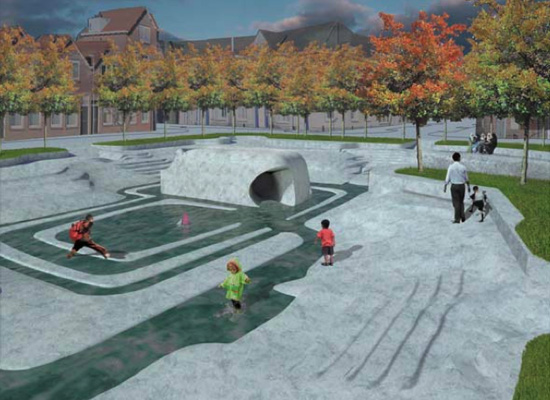
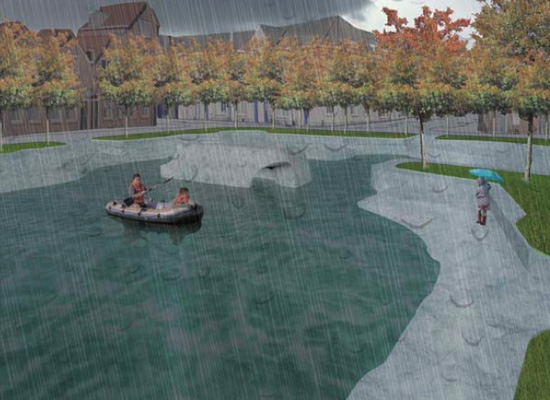
In Florian Boer and Marco Vermeulen's proposal, rainwater runoff isn't funneled into a complex system of underground pipes, a system that is rather expensive to build and maintain, but is managed instead through a network of surface reservoirs, the Waterpleinen, or Watersquares. These storage spaces will be dry for most of the year, but during storm events, they will collect water from the surrounding neighborhood. If one reaches capacity, excess water will overflow into another basin. After the rain, the collected water will slowly recede into nearby bodies of water or seep into the soil.

So instead of being buried in concrete, excised from the daily life of the city and only experienced by municipal workers, urban hydrology is visibly, even prominently, incorporated into the surface fabric of the city. Programmed with recreational opportunities when its dry and even while inundated, its infrastructure provides active public spaces for the local area, not dark playgrounds for a handful of urban explorers. It even becomes an event, its frolicking rivulets and interior lakes staged for the young and old.

Waterpleinen


Originally developed in 2005, this concept has since become official urban policy. At least 25 watersquares are planned for Rotterdam in the coming years, with a prototype to be constructed soon.


Hyperlocalizing Hydrology in the Post-Industrial Urban Landscape

The Wetland Machine of Sidwell

Sidwell Friends School


Reading an ASLA interview of Jose Alminana, a principal at Andropogon Associates, we were reminded that Sidwell Friends School, the Quaker school of choice for the Obamas, the Clintons, the Gores, the Bidens, the Nixons — practically every member of Washington's politocracy, except for the Carters, of course — has in the courtyard of a recently renovated building an artificial wetland.

Not merely an eco-ornament, it's a machine that “manages all the wastewater generated by the building, as well as all the rain water that falls on the site.”

Sidwell Friends School


Typically, wastewater is drained away via a complex network of tunnels that requires vast financial resources just for its maintenance, an infrastructure that's undoubtedly deteriorating just as fast as tax revenues get siphoned off away from public works budgets to General Motors and Bank of America. Miles and miles away from its point of origin, the water then gets treated in an energy intensive process. But it still isn't entirely clean afterwards. Thus, when discharged, it still poses a risk to bodies of water, contributing in many instances to elevated bacterial count and eutrophication.

At Sidwell, wastewater is treated on-site, somewhat off-the-grid and using comparatively minimal infrastructure. The treatment cycle begins inside the building in a tank filled with anaerobic bacteria. Among other things, these bacteria help break down solids. The effluent is then pumped outside to a trickle filter before continuing on by gravity to a series of tiered wetlands. To lessen the health risk of contact with students and to mitigate any odor problems, water flows through beneath layers of pea gravel; there's no surface flow, in other words. This planting medium contains phytoremediating plants which, together with the microorganisms attached to their root hairs and to the gravel stones, extract contaminants from the water. After slowly trickling its way outside for about a couple of days or so, the water then re-enters the building and gets collected in storage tanks as greywater ready for reuse, for instance, to flush toilets.

Sidwell Friends School


Just as with wastewater, managing urban stormwater typically involves massive infrastructure to dispose runoffs as efficiently and as quickly as possible. In addition to being a drain on municipal coffers, such a method is known to increase the probability and the intensity of a flood event during major storms, endangering human life and property. Moreover, since stormwater isn't allowed to remain where it falls, (1) water doesn't have enough time to infiltrate the soil and seep into waiting, possibly depleted groundwater aquifers, and (2) what may have been clean at first contact with the surface undoubtedly will not remain so as it moves through sidewalks, roads, parking lots and sewers before going on to pollute rivers, lakes and other sources of our drinking water.

Sidwell Friends School


At Sidwell, we get a hint of an alternative system for stormwater management: hyperlocal, lo-fi, modular (i.e., implementations at multiple sites would be needed to bring about an appreciable effect on urban hydrology), soft and comparatively cheap.

Sidwell Friends School


Runoff is directed to a rain garden and a permanent biology pond located downslope from the tiered wetlands used for wastewater treatment.

Sidwell Friends School


Some of the runoff gets in an underground cistern. During dry weather, this storage tank provides water to the pond. During heavy rains, excess water flows from the pond into the rain garden, simulating the hydrological dynamics of a floodplain environment. Water seeps through the soil and gets naturally filtered.

Sidwell Friends School


Andropogon describes this project as a “working landscape” but we might prefer calling it an “event landscape,” wherein natural processes are co-opted into a cybernetic amalgam of landscape, architecture, geology, biology and institutional pedagogy. Rather than in the inaccessible subterranean voids and in scientific abstractions, this eco-machine is made to perform out in the open for the edification of the elite who, in their dirty, smelly, real-world engagement with the landscape, will hopefully turn into great stewards of the earth.


On constructed wetlands

Rainwater Harvesting in Quito

Of all the phenomenal spaces concocted by Paisajes Emergentes for their entry in the Parque del Lago ideas competition, our favorite one has to be the open-air theater that doubles as a rainwater storage tank.

Paisajes Emergentes


Or is it a water tank that occasionally hosts cultural events, the itinerary being dependent on weather conditions beyond a day's forecasted precipitation? One can't imagine it functional during the wet season or even during the dry season if rain isn't particularly scarce.

Of course, there's a simple solution: build a floating stage. The number of available seats might then determine what sort of program can be scheduled. If mostly empty, a popular band can be booked. If one or two tiers are available, an experimental play. How about a local production of Mary Zimmerman's Metamorphoses or an avant-garde staging of The Odyssey? A micro-naumachia?

Even in its flooded state, however, the space is still occupiable, a point of interest just like any of the artificial lakes and pools in the park.

Surprisingly adaptable, it's a space attuned to the temporal vagaries of climate, the fluctuating rate of water consumption and the cultural preferences of Quito's residents.


Rainwater Harvesting in Al-Andalus

Hyperlocalizing Hydrology in the Post-Industrial Urban Landscape

Kevin Robert Perry


Last year, Kevin Robert Perry won an ASLA Professional Award for a truly innovative stormwater management system he designed for the city of Portland, Oregon. Referred to as the “first of its kind anywhere,” Perry's project replaced the city's combined storm/sewer pipe system with a landscaped curb extension carved out of a portion of the street's parking zone.

In other words, instead of using expensive and high maintenance system to funnel urban runoffs to distant, equally expensive and high maintenance treatment facilities and discharge points, they are instead managed on-site with simple, cost-effective, attractive and environmentally sustainable infrastructure.

Kevin Robert Perry


And here's how it works:

Stormwater runoff from 10,000 square feet of NE Siskiyou Street and neighboring driveways flows downhill along the existing curb until it reaches the 7-foot wide, 50-foot long curb extensions. An 18-inch wide curb cut allows this water to enter each curb extension. Once water is within the landscape area, the water is retained to a depth of 7 inches by a series of checkdams. Depending on the intensity of a rain event, water will cascade from one "cell" to another until plants and soil absorb the runoff or until the curb extensions reach their storage capacity. The landscape system in place infiltrates water at a rate of 3 inches per hour. If a storm is intense enough, water will exit the landscape area through another curb cut at the end of each curb extension and will flow into the existing street inlets. With the new stormwater curb extensions now in place, nearly all of NE Siskiyou’s annual street runoff, estimated at 225,000 gallons, is managed by its landscape system.


And here's the plant list, which unfortunately makes no mention of genetically modified super-phytoremediating neo-plants:

The plants selected for the NE Siskiyou Green Street are primarily Pacific Northwest natives, such as Oregon grape, sword fern, and grooved rush. Adaptable ornamental species such as blue oat grass, boxleaf euonymus, and New Zealand sedge, were also planted because these species are low-maintenance and fit very well in the neighborhood context. All of the selected plant species are low-growing evergreen varieties with varying colors and textures which always provide year-round interest.


This program, of course, required the participation of the local residents to help realize and, once built, maintain it. As it says in the project statement, “the aesthetic appeal and intrigue of the new stormwater facilities creates a community asset that promotes both environmental stewardship and education at the neighborhood level.”

Kevin Robert Perry


Kevin Robert Perry


Kevin Robert Perry


In looking at the pictures and getting glimpses of context, one could mistake that this sort of project can only be successfully implemented in neighborhoods such as NE Siskkiyou Green Street — fairly well-off parts where residents can exert political influence on street renovations or on anything that can affect property values.

Kevin Robert Perry


But what we find absolutely wonderful about Perry's designs is that they can be applied to economically depressed areas, in inner cities or blighted post-industrial towns, whose local governments find themselves unable to maintain basic infrastructural services.

Either due to a federal administration siphoning away public works money into boyish adventures; an erosion of its tax base as a result of the subprime mortgage crisis; industries closing or moving as demanded by globalization; or even post-oil and post-water realities making current stormwater management practices unsustainable — these same local governments see their public works budget depleted and running in the red, resulting in their neighborhoods taken off the grid.

The expected response of residents would be to move. Some do just that but it's often the case that many would be financially unable and so must then contend with a pestilential landscape of failed sewers, stagnant pools and unappealing vegetation.

It is in this context, we believe, that Perry's designs seem most suited for and are critically needed.

We can even now think of one specific place: East Saint Louis, Illinois.

Kevin Robert Perry


In any case, Perry also won an ASLA Professional Award the previous year for a similar stormwater project, also for the city of Portland, Oregon.

It definitely deserves a look.

Kevin Robert Perry
Kevin Robert Perry


And these before and after photos are worth noting.

Kevin Robert Perry
Kevin Robert Perry


So congratulations to Kevin Robert Perry.


Sustainable Stormwater Management Program, Portland, Oregon


Dispatches from a Post-Water Chicago
Grasscrete©

Grasscrete®

Grasscrete©

These are some of the reasons why we like Grasscrete®.

1) Grasscrete® can make for a fantastic alternative to traditional municipal stormwater management.

In urban areas, stormwater management system usually involves collecting and disposing stormwater as efficiently and quickly as possible. Once “run-off” is generated by sidewalks, streets and parking lots, it is immediately conveyed to storm sewers and then to discharge points. When there is a major storm event, large volumes of water get funneled out in a relatively short amount of time.

In non-urbanized areas such as woodlands and farmlands, however, there are three ways for the water to drain off the land: (a) by simply flowing out on the surface; (b) by infiltrating the soil and seeping into the groundwater; and (c) through evapotranspiration. During a similar major storm event, what doesn't get sucked in and evapotranspirated by the vegetation takes its sweet good time leaving.

To simplify things a bit here, let's take an empty flowerpot. It's our metaphorical city--all hardscapes, all impervious surfaces. Pour a bottle of water into it, and the water drains in a torrent in seconds flat, making a watery mess on your table and floor. If the table and floor are metaphorically your downstream neighbors, then they would all have drowned.

Pour the same amount into a pot with soil and plants, and the water will trickle out over a longer period of time. There might still be a watery mess, but that will be manageable.

What makes Grasscrete® a fantastic alternative, then, is that it mimics the condition of the second scenario. It decreases the amount of surface area taken up by hard paving as well as the area of land served by storm sewers.

But most importantly, it can mitigate the destructive force of floods.


2) Grasscrete® can save lives.

See the last sentence in #1.


3) Grasscrete® can save you money.

See the last sentence in #1.


4) Grasscrete® can save you lots and lots and lots of money.

Most new developments require extending sewer lines beyond their current limit. This obviously costs money. And maintaining it again costs money. But by allowing stormwater to seep into the ground, Grasscrete® may preclude the need for new drains and detentions. If sewers are built nonetheless, Grasscrete® can theoretically divert all the rainwater away from the sewers, thus reducing wear and tear and minimizing maintenance cost.

Moreover, with less severe floods, levees and other flood protection may no longer be needed while existing ones would require less repairs.

In some major metropolitan areas, such as Chicago, billions and billions (and billions) of dollars have been spent to construct huge underground tunnels to temporarily store stormwater. There are still neighborhoods in Chicago that flood, even after mild thunderstorms. Perhaps a less monumental, less costly system should have been considered.


5) Grasscrete® can reduce pollution and improve water quality.

Roofs and streets are full of shit, literally. Rainwater that may or may not already be corrosively acidic will surely turn toxic the minute it hits pavement.
And where does the water end up? In our rivers, lakes and drinking water.

Since Grasscrete® has a vegetated void that can be planted with hardy phytoremediating grasses rather than the standards, it may filter out some of the pollutants.

Of course, for these phytoremediating grasses to clean the run-off, the water needs to sit still for a bit, something that you don't want on the streets. In which case, super-phytoremediating transgenic grasses will be used instead.


6) Grasscrete® can improve the quality of life.

See #1-#5.

Additionally, not only is it aesthetically beautiful, or at least less of a strain on the eyes than huge swats of Wal-Mart asphalt, the reintroduction of vegetation into former concrete jungles should counteract the urban heat island effect.


7) Grasscrete® looks utterly vampiric. Landscape on a rampage, sucking the concrete out of buildings, highways and dams. It's the anti-Architecture kudzu reigning supreme in the Edenic Apocalypse.

Grasscrete©

Grasscrete©

Grasscrete©

Grasscrete©

Grasscrete©

Grasscrete©

Grasscrete©

Grasscrete©

Grasscrete©

Grasscrete©


Biopaver by Joseph Hagerman

Dispatches from a Post-Water Chicago

Growing Water by UrbanLab

We failed to mention it when it was chosen to represent Chicago in the History Channel-sponsored “City of the Future” competition, and then failed again when it beat out the other two notable entries from New York and Los Angeles. For a Chicago-based blog with an extraordinarily abnormal interest in hydrology, hydroengineering and hydropolitics, this is downright criminally negligent.

So to make amends, we'll take some excerpts from a recent article in the Chicago Reader on the winning proposal: Growing Water by Sarah Dunn and Martin Felsen of UrbanLab.

Growing Water by UrbanLab

Rather than collecting and transporting wastewater through a mindbogglingly complex network of sewers to a massive central building complex, the whole city becomes one giant ecological machine treating and recycling 100% of the water it uses: “A series of 50 'eco-boulevards' spaced every half mile from Rogers Park to Roseland would run east-west from Lake Michigan to the subcontinental divide between the Great Lakes and Mississippi River basins at about Harlem Avenue--thin green ribbons running across the city that would replace pavement with green space, greenhouses, and wetlands for the treatment of waste and storm water.”

Not only will these eco-boulevards clean up wastewater and act as temporary storage sites for storm water, they will double as parklands as well, a new green infrastructure to supplement the city's “Emerald Necklace” of public parks, boulevards and waterways. New constructed wetlands, prairies and forests, botanical gardens, organic farms, fishing holes and swimming ponds, wildlife preserves and woodland trails to remake the city in the image of its own motto: Urbs in Horto, or City in a Garden.

Furthermore, “each eco-boulevard would jut out into Lake Michigan and end in a man-made peninsula to accomodate solar arrays, wind turbines, and geothermal wells to power the treatment processes. 'Terminal Parks' would mark the eco-boulevard's western extremes. These large green spaces would be surrounded by a residential and work complexes to accommodate returnees from the outer suburbs,” possibly reducing sprawl.

Growing Water by UrbanLab

Growing Water by UrbanLab

Of course, this will make two of Chicago's great engineering feats redundant. Firstly, the Chicago River, which was reversed in 1900 by the 28-mile-long Chicago Sanitary and Ship Canal, can be re-reversed so as not to drain freshwater any further from the lake and then dump this increasingly precious commodity into the Gulf of Mexico where it becomes useless.

Secondly, the multi-decade, multi-billion dollar 109-mile Deep Water Tunnel will be converted for new subway lines, which will alleviate increased urbanization. But while those billions taken out of taxpayers may not be recovered, other cities may be inspired to find less expensive alternatives to wastewater treatment and stormwater management.

Growing Water by UrbanLab

For those in Chicago next week on June 8th, the model built for the competition, as well as the other two finalists and the other Chicago entries, will go on display at the Museum of Science and Industry.

Biopaver by Joseph Hagerman

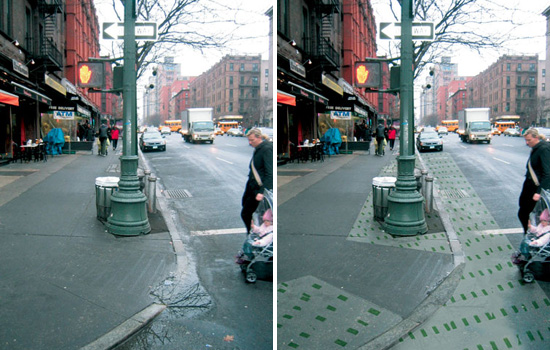
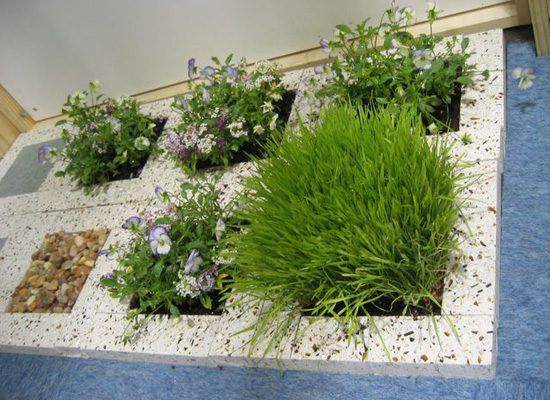
Ecologically sound pavers as alternative to impervious surfaces like asphalt and concrete are nothing new. What is novel about Biopaver, by Columbia graduate student Joseph Hagerman, is the addition of a biological core of phytoremediating plants that filters out pollutants from storm water runoff. It represents a synthesis of techonology, ecological process, and design.

Biopaver by Joseph Hagerman


Biopager by Joseph Hagerman


Biopaver by Joseph Hagerman