Showing posts with label tsunami. Show all posts

Close race seen to select next Japanese leader

A close race emerged Saturday among the men seeking to replace Prime Minister Naoto Kan and lead Japan as it emerges from its worst disaster since World War II, with five declaring their candidacy for the ruling party's top spot.

Kan announced Friday he would resign after serving nearly 15 months that have been plagued by ruling party infighting, gridlock in parliament and clamorous criticism of his administration's tepid initial reponse to the March 11 earthquake and tsunami and ensuing nuclear crisis.

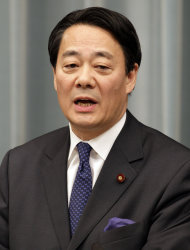
A new leader is to be chosen Monday. Public opinion polls show that the favorite to replace Kan is former Foreign Minister Seiji Maehara, but Trade Minister Banri Kaieda has emerged as a strong contender said he was backed by veteran party power broker Ichiro Ozawa.

The Japanese public, yearning for political unity and resolve in the wake of the disasters, has grown disgusted with the squabbles and blame-trading that have dominated parliamentary sessions.

The five members of the ruling Democratic Party of Japan who declared their candidacies after Kan's announcement planned to hold news conferences and debates Saturday and Sunday. Then, the party's 398 members of parliament were to vote Monday to choose the new party chief, who will almost certainly become prime minister because of the party's majority in the more powerful lower house.

Kan's successor will become Japan's sixth prime minister in five years, perpetuating the high turnover in political leadership even as the country grapples with a sluggish economy, an aging population and the enormous reconstruction effort after the country's triple disaster.

So far, candidates running for party chief have spelled out little about their vision for post-tsunami reconstruction or other serious issues, such as tackling the bulging national debt. Most of them also have not taken a clear stance on the future of atomic power despite growing public worries about meltdowns at the Fukushima Dai-ichi nuclear power plant.

In the murky world of faction-dominated Japanese politics, they seem more concerned about getting votes from fellow party members and shoring up their base of support, experts say.

The party leadership race could end up as a duel between the relatively young and telegenic Maehara, the former foreign minister, and Kaieda, the economy minister, who reportedly has the backing of party stalwart Ozawa.

A China hawk, Maehara, 49, gained prominence by taking a firm stand toward Beijing during a territorial spat last year over some disputed islands in the East China Sea. He is strongly pro-Washington and supports a close security alliance with the U.S.

Other candidates in the party leadership race include Finance Minister Yoshihiko Noda, who has spent recent weeks contending with the yen's record appreciation that is hurting Japan's exporters, former Transport Minister Sumio Mabuchi and Farm Minister Michihiko Kano.

After Monday's party vote, the new Cabinet could be installed as early as Tuesday.
U.S. Vice President lauds Japan's resolve in tsunami

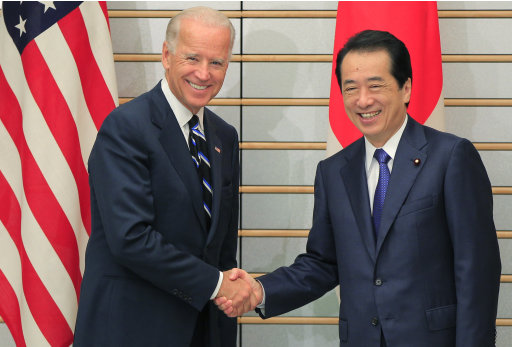
U.S. Vice President Joe Biden expressed admiration for the stoicism of the Japanese people in their efforts to recover from the tsunami, as he met Tuesday with Japan's prime minister on the third and final leg of an Asian tour.

Prime Minister Naoto Kan thanked Biden for the United States' "enormous assistance" after the disaster, when among other things American military personnel helped reopen the damaged airport at Sendai, where Biden was to give a speech later Tuesday. He also was scheduled to visit evacuees living in temporary housing along the devastated northeastern coastline.

"Looking at it from afar, it was absolutely breathtaking, heartbreaking," Biden said of the March 11 disaster, which left just over 20,000 people dead and missing. He said the American public was impressed with the stoicism and resolve of the Japanese people, calling it a model for the whole world.

Biden also reaffirmed the countries' alliance and economic ties. Under a security pact, nearly 50,000 American troops stationed in Japan.

Referring to the natural disaster in Japan and budget problems in the U.S., Biden said, "There are voices in the world who are counting us out. They are making a very bad bet."

Kan said Biden's trip — his first to Asia as vice president — demonstrates that "Japan is open for business."

Biden is spending two days in Japan, the final stop of an eight-day trip to Asia that already took him to China and Mongolia.

His visit to Japan comes at a time of widespread speculation that Kan will resign in coming weeks or even days over his administration's perceived lack of leadership in handling the triple crisis — the earthquake, tsunami and nuclear accident at the Fukushima Dai-ichi plant, located between Sendai and Tokyo.

More broadly, Biden's visit comes amid China's rising economic, military and political clout that is somewhat overshadowing Japan, which is wrestling with a two-decade economic slump, bulging deficit and aging population — and now recovery from a threefold disaster.

In China, Biden had extensive face-time with the country's expected future leader, Xi Jinping, and delivered a strong message of the mutual interdependence between the U.S. and China, the world's two biggest economies.

Biden also made the case for continued U.S. economic vitality despite current budget woes and sought to reassure China's leaders and ordinary citizens about the safety of their assets in the United States following the downgrading of America's credit rating.

On Wednesday, Biden plans to visit a U.S. air force base west of Tokyo to thank military and civilian personnel for helping with relief and recovery efforts in the wake of the disaster.