Showing posts with label U.S.. Show all posts

U.S. Vice President lauds Japan's resolve in tsunami

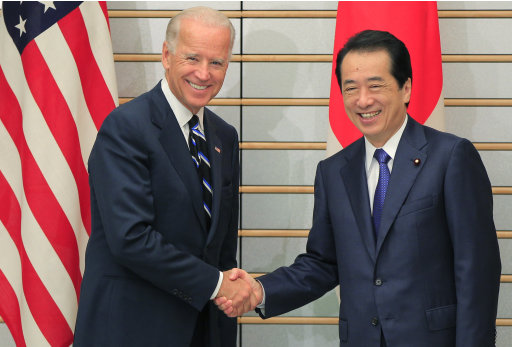
U.S. Vice President Joe Biden expressed admiration for the stoicism of the Japanese people in their efforts to recover from the tsunami, as he met Tuesday with Japan's prime minister on the third and final leg of an Asian tour.

Prime Minister Naoto Kan thanked Biden for the United States' "enormous assistance" after the disaster, when among other things American military personnel helped reopen the damaged airport at Sendai, where Biden was to give a speech later Tuesday. He also was scheduled to visit evacuees living in temporary housing along the devastated northeastern coastline.

"Looking at it from afar, it was absolutely breathtaking, heartbreaking," Biden said of the March 11 disaster, which left just over 20,000 people dead and missing. He said the American public was impressed with the stoicism and resolve of the Japanese people, calling it a model for the whole world.

Biden also reaffirmed the countries' alliance and economic ties. Under a security pact, nearly 50,000 American troops stationed in Japan.

Referring to the natural disaster in Japan and budget problems in the U.S., Biden said, "There are voices in the world who are counting us out. They are making a very bad bet."

Kan said Biden's trip — his first to Asia as vice president — demonstrates that "Japan is open for business."

Biden is spending two days in Japan, the final stop of an eight-day trip to Asia that already took him to China and Mongolia.

His visit to Japan comes at a time of widespread speculation that Kan will resign in coming weeks or even days over his administration's perceived lack of leadership in handling the triple crisis — the earthquake, tsunami and nuclear accident at the Fukushima Dai-ichi plant, located between Sendai and Tokyo.

More broadly, Biden's visit comes amid China's rising economic, military and political clout that is somewhat overshadowing Japan, which is wrestling with a two-decade economic slump, bulging deficit and aging population — and now recovery from a threefold disaster.

In China, Biden had extensive face-time with the country's expected future leader, Xi Jinping, and delivered a strong message of the mutual interdependence between the U.S. and China, the world's two biggest economies.

Biden also made the case for continued U.S. economic vitality despite current budget woes and sought to reassure China's leaders and ordinary citizens about the safety of their assets in the United States following the downgrading of America's credit rating.

On Wednesday, Biden plans to visit a U.S. air force base west of Tokyo to thank military and civilian personnel for helping with relief and recovery efforts in the wake of the disaster.

U.S. could call for Al-Assad for violence in Syria

The international cries for Syria's government to end a bloody crackdown on civilians could intensify Wednesday as activist groups reported fresh onslaughts in several cities.

The United Nations Security Council is expected today to follow up on a statement last week that condemned the Syrian regime for attacks on peaceful protesters and called for both sides to end the violence.

U.S. government sources told, The United States is moving toward issuing an explicit call for Syrian President Bashar al-Assad to step down.

The move is expected to be announced in coming days after U.S. officials consult with the United Nations Security Council, they said the question of whether to call for al-Assad to step down has been under discussion over the past few weeks.

While international leaders mull their next steps, heavy gunfire, explosions and tanks permeated the eastern city of Deir Ezzor on today.

The observatory said in morning, "There are also large scale arrests in those areas as mobile service and landline communications have been completely cut out in the areas since the start of the military operation."

The conflict in Syria was fueled five months ago when Syrian forces swiftly suppressed protests in the southern city of Daraa.

On Tuesday, Turkish Foreign Minister Ahmet Davutoglu and al-Assad engaged in more than six hours of talks in Damascus.

Davutoglu told, "Our primary target is the bloodshed to stop,". "We shared what needs to be done for the bloodshed to stop, for the civilian losses to end and for the political reform process, in line with the people's demands, to take place."

Al-Assad told Davutoglu that his country won't relent in chasing down the "armed terrorist groups" it blames for the violence that has engulfed the nation.

Al-Assad briefed Davutoglu on the killing and terrorizing in some Syrian cities by the purported groups. At the same time, he indicated that Syria is committed to reform and is open to help from other countries.

Russia called on the Syrian government Tuesday "to stop the violence and to introduce deep political changes," the Russian Foreign Ministry.

A Saudi Arabia's King Abdullah has condemned violence in Syria in a rare rebuke directed at a fellow Arab leader, who leads a majority Sunni Muslim nation with a government dominated by minority Alawites, whose faith is a spinoff of Shiite Islam. Abdullah demanded an end "to the killing machine and the bloodshed."

"A mere diplomatic appeal to the Syrian authorities to end the ongoing violence against civilians will fall far short of what the situation demands."

World Market Rout is not Loud : Confidence Vote in Leaders

Global markets have issued a vote of no confidence in the management of the world’s two largest economies, the U.S. and the euro area. To regain credibility, leaders on both sides of the Atlantic need to recognize the magnitude of the crisis they face.

The outlook reflected by the market rout is not encouraging, coming as it does after European and U.S. officials thought they were doing enough to fix their similar -- and overlapping -- fiscal problems.

This week’s deal to raise the U.S. debt ceiling is a case in point. Given the exceedingly weak recovery, the U.S. government should stand ready to provide more stimulus. To prevent larger deficits from harming its credit standing, the U.S. must also convince investors that it is capable of putting its long-term finances on a sustainable path.

The deal that Congress and the White House ultimately struck doesn’t come close to solving the government’s long-term problems, but threatens spending cuts that could weigh heavily on economic growth in the short term.

Thursday’s moves in the markets gave a taste of how costly politicians’ dithering can be. The drop in world stock markets represents hundreds of billions of dollars in lost value. Italy’s cost of borrowing, as measured by the yield on its 10- year government bond, rose to a new euro-era high of 6.18 percent.

 Europe’s leaders should demonstrate that they stand together, ready to do what it takes to restore confidence. This would involve issuing jointly backed euro bonds to replace most or all of the debts of struggling governments.

In the U.S., the government must be prepared to boost consumer demand, and that means putting people back to work. Ideally, a comprehensive plan to fix the country’s long-term finances could be combined with a shorter-term stimulus. President Barack Obama is already promising to pivot from debt talks to a national jobs program. But having just completed punishing negotiations over spending cuts, he has very little hope of finding new money -- and little time to waste.

Barring a major new stimulus program, some steps can be taken. Obama could ask Congress to quickly adopt a jobs tax credit, renew clean energy tax breaks and temporarily waive federal environmental, labor and other requirements that delay public works programs, all moves that would put workers back on private payrolls.

When the Federal Reserve meets on Aug. 9, it should signal that it’s ready to do its part, too. Among the stimulative tools at its disposal: Pledging to hold onto the U.S. Treasury bonds it has accumulated in its quantitative-easing programs, and to reinvest the proceeds from any maturing securities in government debt. It could announce that it plans to keep its key interest rate near zero for a longer, more defined period. It could lower the 0.25 percent interest rate it pays banks that park excess reserves at the central bank, to prompt more lending and investing. And it could replace the shorter-term securities it holds on its $2.9 trillion balance sheet with longer-term ones, to push down those rates as well.

Ultimately, markets may force politicians and policy makers to implement all these measures and more. The world will be much better off if they find the will to get ahead of the curve.

Study Suggests: France, U.S. Have Highest Depression Rates

According a survey found that More people are being depressed in France and the U.S. than anywhere in the world, more than 89,000 people in 18 different countries.

The World Health Organization, found that 21 percent of people in France and 19.2 percent of people in the U.S. reported having an extended period of depression within their lifetime. According to the study, on average, 15 percent of people in high-income countries compared with 11 percent in low-income countries,

There are a lot of people in the U.S. who say they aren’t satisfied with their lives. According to the Geneva-based WHO, Depression affects nearly 121 million people worldwide and is the second leading contributor to shorter lifespan and poor health for individuals 15-44 years of age.

 Kessler who is a professor of health care policy at Harvard Medical School in Boston, Massachusetts, said, the disease is the third-largest contributor to lowered productivity in the workplace.
Depression Differences

Researchers took into account both clinical depression, a biological condition that leads to low self-esteem and loss of interest in otherwise enjoyable activities, and types of mild depression, which can be situational or caused by environmental influences.

“There’s no change in biological depression, but what’s going up is the more mild depression,” Kessler said. “Objective things haven’t changed. We have an expectation that everything’s going to turn out perfect but it doesn’t.”

Scientists from twenty different institutions worldwide worked with the WHO’s World Mental Health Survey Initiative, obtaining data by interviewing 89,037 people in 18 different countries from 2000 to 2005. Trained interviewers spoke with respondents in person or over the phone about traumatic events in that person’s life, substance abuse, relationships, happiness, and other factors that could influence mental health.

The report also found that women were twice as likely to experience depression, and the strongest link to depression was separation or divorce from a partner.

 Lead researcher Evelyn Bromet, a professor and epidemiologist at Stony Brook University Medical Center in Stony Brook, New Yorks aid, “Most people that come out of medical school or residencies do not learn about depression, so they don’t know how to recognize it.”