It seems like everywhere you turn this week you hit something BIG, either their ski mountain incinerator plant or their pyramid condo. We though we'd join in all the drive-by copy-pasting fun with a favorite project: their design proposal for a crematorium in the famed Woodland Cemetery in Stockholm, Sweden.
“The new crematorium,” they write, “will be located in a small clearing within the piece of untouched forest.” This clearing can be reached via 3 paths: “two for the pedestrian that cross each other in the clearing, and one for vehicles to reach the clearing and return. At this intersection we imagine the new crematorium as a clearing in the forest rather than a built object. The two intersecting paths carve through the soil of the undergrowth descending slowly while opening the ground up to the light and the air of the skies above.”
As a counter proposal, instead of this high energy funeral rite, how about a forest version of a Zoroastrian Tower of Silence or a Tibetan sky burial? Low energy but still utra rapid atomization.
After scientists had perfected the technique of splicing human DNA into the DNA of a tree, the Bureau of Forestry, the department which is responsible for the more than half a million trees on public right-of-ways, entered into a business partnership with the multi-billion dollar funeral industry to turn the city's urban forest into a living necropolis.
In previous revenue-generating schemes, the perennially cash-strapped city had privatized its airports, toll roads, parking meters &mdash much of its public infrastructure, in fact &mdash which proved disastrous. Not so with this arboreal venture.
The number of trees increased exponentially, even the types of species used. Every tree is lush and vigorous, since not only are they well maintained by caretakers with an eternally flowing revenue stream but also by the bereaved, who in their grief come daily to tend lovingly to the trees and the surrounding planting beds. Tear-drenched anguish has been appropriated into the city beautification program.
The sidewalks, too, look immaculate. Not a single stray candy wrapper can be found, and no one dares urinate on the botanically re-encoded dead. The pavement, after all, is now hallowed ground.
On the Day of the Dead, the streets in the city's many Hispanic neighborhoods become the site of deliriously exuberant block parties. Arbor Day is moved to coincide with Memorial Day.
Later, Google pays exorbitantly for the rights to geospatilize and network the data on all the trees onto its suite of web mapping service applications. Consequently, gravesite visits needn't be performed exclusively in real space; the pilgrimage can now be undertaken virtually. From anywhere and at anytime, you can check up on how the tree is faring, see it grow and mature and bear transgenic fruits, watch as your loved one unconsciously experience an after life.
There is actually a lighthouse, this one in the Pacific, that has been turned into a columbarium.
Called the Tillamook Rock Lighthouse, it sits on a rugged island just off the coast of Oregon state. From above it looks like a solitary Greek monastery sitting precipitously on a promontory, one of only a few in the Athosian peninsula to escape a future deluge.
And it just might look like an ideal sanctuary to store your remains, a picture-postcard perfect locale where your family and friends might at least enjoy visiting, with a phenomenal view to alleviate their grief.
Except, of course, for a couple of things:
1) Eternity by the Sea Columbarium, the company who owns the lighthouse and who converted it into a cemetery, lost their license in 1999 because of inaccurate record keeping and because their columbarium isn't technically one. The urns, which are supposed to be placed in niches, rest instead on boards and concrete blocks.
When the company tried to get a new license in 2005, their application was rejected. They now spend most of their time and money on lawsuits filed against them.
2) The sea is so treacherous that a helicopter is the only way to reach it — that is, if the owner of the island, the Oregon Coast National Wildlife Refuge Complex, even allows you passage to the lighthouse in the mild weather of spring and summer when seabirds are nesting.
But if you're one who's not looking for a peaceful rest in your unconscious days of being dead; actually prefers the thunderous sound of ocean waves constantly slamming into the rocks; doesn't mind sharing quarters with cormorants and common murres; and is thoroughly amused by the image of Charon as a helicopter pilot ferrying your soul across the Styx on whirring oars, then simply contact the proprietors.
They're still making offers for space. Even if they don't have a license.
However, there are some alternatives, for instance, this flippin'ship.
Known formally as the R/P FLIP, it's a mobile research station used by the Scripps Institution of Oceanography principally to “study how sound waves behave under water,” but during its 40 years of operation it has also collected data on the “way water circulates, how storm waves are formed, how seismic waves move, how heat is exchanged between the ocean and the atmosphere, and the sound made underwater by marine animals.”
You can see it position itself vertically, as well as the crew, refrigerators, stoves and coffee pots adjusting to the changing spatial configuration, in this short video.
The ship is the only one of its kind, but surely hundreds should be built, each one interning the pulverized remains of the dead. Or housing a single occupant. One could be the family mausoleum of a Greek shipping magnate. Thousands. Tens of thousands.
A not-so-little forest of columbaria bobbing about in the future ice-free waters of an auroral Arctic.
Should their ballast decay and the whole vessel sinks to the bottom of the ocean, it will simply be a return to standard practices.
It's about that time of year again, a few weeks before the anniversary of this blog when we go searching for something special to treat ourselves with. For the first anniversary, we ordered a few of these architectural notecards by Andrew Zega & Bernd H. Adams. Last year we looked into getting a weather modification machine, specifically this portable hurricane, before deciding to buy a couple more notecards.
This year, we'll probably just order yet more notecards, although what we really want is this lighthouse, pictured above, which is being auctioned off by the fantastically named U.S. Office of Property Disposals. It's located in Chesapeake Bay about 5 nautical miles from the nearest shore. It has “elements of the Second Empire architectural style,” we read.
When the auction ends, perhaps we'll learn that Zega & Adams gave the winning bid. They plan to remodel it into a chinoiserie pavilion, so that they can reenact some of the wildest garden debaucheries of Marie Antoinette.
Or preferably, we find out that a fan of Arnold Böcklin is the new owner. He wants to convert the building into a columbarium.
In still weather or rougher seas, the dead will metaphorically cross the Styx to their final resting place, which in its former life illuminated and guided the lost but, like them, is now extinguished.
For the most recent issue of Vice Magazine, the mono-appellated Bahag explored a cemetery colonized by thousands of families who have transformed it into a thriving necropolis.
Tucked within the hyper-saturated Philippine capital, Manila, the denizens (opportunistic urban planners, if you will) of this supposedly counter-urban void have augmented it with some of the trappings of urban living: shared public spaces, vernacular customs, an informal service infrastructure, classrooms and even several karaoke bars.
Quoting Bahag:
Some families ended up here almost accidentally. Some inherited the mausoleums that they now live in from their great-grandparents. Others came from the provinces and couldn’t make enough money to live in the big city. In all cases, they’re basically families with nowhere else to go.
The people who live here manage to extract livelihoods from the dead. Teenagers carry coffins for 50 Filipino pesos—about 50 American cents. Children collect scrap metal, plastic, and other garbage to sell. Their fathers are employed to repair and maintain tombs while their mothers maintain the house, which could be the family mausoleum or the mausoleum of their employers. Rent-free shanties are wedged between or on top of crypts.
It's an adaptive reuse carried out at an urban scale, a reflection of economic realities and communal creativity rather than a particular disregard for the dead.
What does one find there in the park? “All that is apparent upon the surface,” writes Bowring, “is an enigmatic formation of small circular holes of unknown depth. Their configuration appears significant, as is the nature of the open cavity below. At night, light shines up from inside this curious cavern, emitting an unearthly glow from within the earth. The constellation of points is even more apparent at this time, an inflected grid, whose very presence appears to announce an absence.”
Bowring again: “The cavern below the pattern of oculi is revealed to be the negative form of a building. The whole negative structure has been cast from an iconic architectural object, Le Corbusier's Villa Savoye, and this cast then inverted and placed into the ground. The holes are the negative space of the pilotis, meeting the ground, from beneath rather than from above. The lost object is suppressed as a subterranean subconscious, the landscape of sadness of the Park of the Lost Object.”
The project is fantastic, beautifully conceived and rendered, thought-provoking. It fails to convince us, however, that the landscape would necessarily be “plunged into grief, for the loss of the object” and would have “no wish to regain happiness” and that the site of absence is an “open wound”, a “melancholy place of loneliness,” as if its continued happiness is dependent upon artifacts. Furthermore, there are others who would consider Architecture justly subsumed by Landscape a cause for a celebratory bacchanalia at the Palms Casino, after which, all will awaken in the full blast of the afternoon sun many, many hours later—groggy, migrained but joyous—to a paradigm shift.
What we can be entirely convinced of is that a Villa Savoye entombed is a truly and supremely hysterical scenario.
But hilarity can immediately revert back to “melancholy weightiness” if one mentions the Crandall Canyon Mine, the site of the most recent major mine disaster in the U.S.
As most American viewers are well aware, six workers were trapped at the Utah mine after a coal mine bump. During the rescue operations, holes were drilled from the surface into chambers where the miners may have sought refuge. Atmospheric sensors, microphones and cameras were then lowered to check for signs of the men, but unfortunately, none were detected. Except for the relentless drip of hydrology and phantom sounds of speculated conversations, not much was heard.
All that was recorded and shown during live news conferences was the negative cast of a generic architecture--walls, ceilings, floors, space, anti-gravity supports--embedded in geology, disintegrating, metamorphosing into its own burial chamber and, as was increasingly feared then and very much likely now, into the subterranean tombs of the miners.
And to quote one official from the mine: “There was zero void.”
Also shown during the televised news conferences were maps of the mine, showing its passageways, compartments, entryways and exits. And marked on the pages are the locations of the seven boreholes.
If you were to tell us that the maps might just as well be the architectural plans of the Villa Savoye or the combined plans of every pharaonic tombs in the Valleys of the Kings and Queens, you would be correct. Because they are.
And if you were to tell us that the marked boreholes remind you of Bowring's oculi, the surface presence of untraceable “subterranean subconscious” folding back into the earth, that's because Bowring is a genius and she intended it.
The Crandall Canyon Mine as Park of the Lost Object v2.0.
One wonders if Bowring is an avid spelunker, scheming to embedded, say, St. Peter's or Guggenheim Bilbao, upside down and counter-axial, inside New Zealand's Southern Alps, where she'll rappel until she can't rappel no more.
Parked right now till 28 October 2007 at the Doris C. Freeman Plaza in Central Park is Damián Ortega's Obelisco Transportable, a 20-foot-tall “'mobile landmark' that one could potentially move anywhere to commemorate anything.”
Is is “a nod to the ways in which public sculptures and monuments have historically been moved from one city to another. Ortega describes this as the 'Napoleonic gesture,' in which the wartime victor plunders the monuments of captured cities and brings them back home to be installed in public there as a symbol of victory. Such transfers were meant to signal the rise of a new power and the demise of an older one, as well as an exchange of central and peripheral positions. Cleopatra's Needle in Central Park, for example, was originally created in Heliopolis, the ancient Egyptian city, more than 3,000 years ago. During the time of the Roman Empire, it was moved to Alexandria, where it remained for almost two millennia before being offered to the United States as a gift in the 19th century.”
We can't help here suggesting that Ortega should give Ikea permission to mass produce and sell his reusable memorials, because, firstly, we like to imagine them multiplying exponentially in public spaces everywhere (and no, there is still not nearly enough memorials), and, secondly, we also like the image of people scouring the city—a sort of pre-funerary cortege mixed in with some urban sightseeing—for an abandoned obelisk, one commemorating something already forgotten in the collective memory and thus can now be reused.
Other scenarios abound. For instance, one day of the year, those obelisks-on-wheels commemorating soldiers killed in the Global War on Terror are paraded through the city, like an Easter Procession. Before they are returned to their original sites, they would all be collected in the a central plaza, a formation reminiscent of Eisenman's Memorial to the Murdered Jews in Europe. Alternatively, they could be arranged less formally, more crowded, as haphazard as a favela. In any case, the sight of it all would be quite dramatic, a powerful statement on the consequences of war.
Another day might be set aside for victims of natural disasters and another for bicyclists killed by lunatic motorists.
Roadside memorials will similarly be made mobile, traveling the same route which the unfortunate souls they're memorializing may have taken. (Or seeking revenge?) But then they themselves will be involved in an accident.
That cemeteries can be a place other than for eternal rest, mourning, and the occasional architecture tour is not unheard of, but the list of activities seem to be growing ever more varied and outlandish.
“Historic cemeteries, desperate for money to pay for badly needed restorations, are reaching out to the public in ever more unusual ways, with dog parades, bird-watching lectures, Sunday jazz concerts, brunches with star chefs, Halloween parties in the crematory and even a nudie calendar,” reports the New York Times.
Moreover, at Philadelphia's Laurel Hill Cemetery where six Titanic victims are buried, tourists can dine on a “nine-course re-creation of the last supper aboard [the] ill-fated ocean liner.” Oakwood Cemetery, which previously hosted a medieval-style wedding, will have a Renaissance fair this summer, complete with jousting tournaments. And recently at the Congressional Cemetery in Washington, “a 70-piece marching band serenaded the grave of John Philip Sousa, and dog owners held a parade for dogs dressed as historical cemetery personages, including a Union soldier.”
So if cities ever want to reactivate dead urban spaces, they need only put some dead bodies there, preferably of famous people, and in mausoleums designed by Rem Koolhaas and Ken Smith.
Going through an archive of half-forgotten bookmarks, we discovered this FORGEMIND.archi.mediaarticle on Enric Miralles and Carme Pinós' Igualada Cemetery located near Barcelona, Spain.
You'll read something about “time architecture” and about life journeys and about space-time-metaphysical continuum and about layering of memories and such. But you'll be forgiven if you skip the whole text and simply peruse the photos, which are many, capture perfectly the essence of the site, and unequivocally support what we've long suspected: that the Igualada Cemetery could be a model for an entirely new flood control system, one that is part levee, part diversionary canal, part city of the dead.
The authors may suspect this as well: “The project is conceived,” they write, “as an earthwork that transforms the surrounding landscape and also as a metaphor for the river of life. A processional route descends from the entrance, where crossed, rusting steel poles which double as gates, proclaim the start of the journey along a winding path where railway sleepers are set into the concrete surface towards the burial area. The route is lined with repeatable concrete loculi forming retaining walls.”
A landscape of concretized rigidity and suppleness, of permanence and impermanence, protecting the living from surging waters, avalanches and supersonic pyroclastic mud flows while welcoming those it could not save.
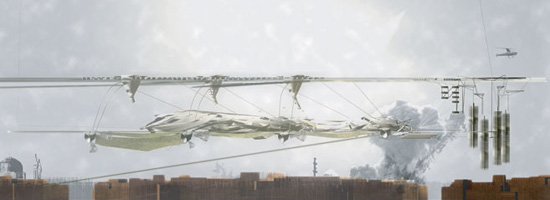
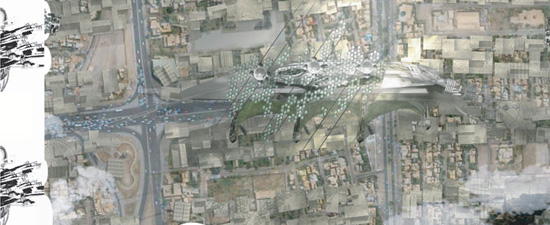
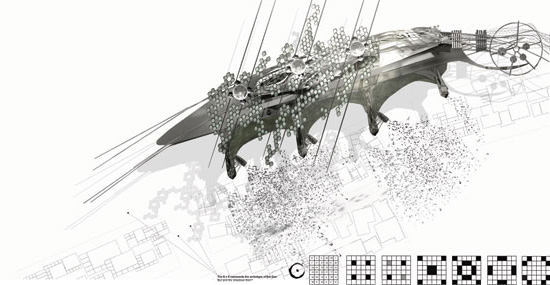
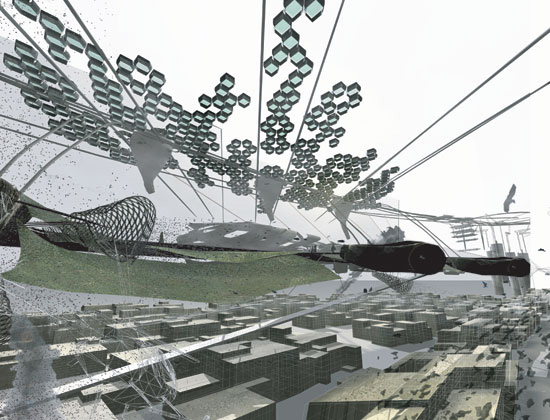
Nannette Jackowski and Ricardo O. C. de Ostos, both recently tasked to author the next installment of Pamphlet Architecture, once proposed “a gigantic presence of a hanging funeral structure” that will hover above the war torn streets of Baghdad, floating unceasingly “from bright explosive mornings to airless night hours,” and lush with growth from an endless supply of dead Iraqis.
“Day by day, nearly hourly, it updates its assimilating heavy stocks, a statistic of a hundred thousand Iraqi corpses or maybe twenty five thousand.”
Lest someone say that this can never be built, a prototype already exists in the skies above Iraq. To see it, one only needs to track the endless flights of cargo planes delivering dead coalition soldiers back to their home countries. And also the countless parabolic airborne tracings of the injured getting airlifted from battlefields to waiting “cash” units; of celebrities and politicians for Thanksgiving or dubious fact-finding missions; and of celebrity journalists, some of whom will simply add to the spectacle and cause their audience to see the events they cover “as nothing more than a special effect or just another reality TV show” before they get seriously injured and are then swiftly flown away.
To cap our unintended series of posts on sacred landscapes, let us point you first to contour crafting, a fabrication technology being developed by Behrokh Khoshnevis whereby “a single house or a colony of houses, each with possibly a different design, may be automatically constructed in a single run, embedded in each house all the conduits for electrical, plumbing and air-conditioning.”
And then to Gallica, from where you can download the following images of Etienne-Louis Boullée's designs for tombs and memorials.
It's rather unfortunate that Khoshnevis and Boullée did not live in same century. What beautiful collaborations they might have had.
And everyone could easily have ordered cheap Pharaonic mausoleums towering over cities and landscapes. Entire provinces or states or even whole nations becoming literally valleys of the dead, hosting hundreds of encapsulated monumental voids.
Apparently, some of the people displaced by the devastating floods in Jakarta have found shelter in a cemetery located in the center of the city.
“For several hundred evacuees,” reports The New York Times, “the cemetery offered a refuge, with public toilets and working water pumps for washing. An informal community has emerged there, with women cooking donated food at a communal fire under a big blue tarpaulin.”
Says one evacuee, “We are afraid to sleep in the cemetery. But we have no other place to go. We are sleeping among the dead.”
But “during the day, the cemetery is now a lively place, as displaced people from surrounding neighborhoods come to wash at its pumps and use its outdoor toilets.”
Cemeteries, planned on high ground, sacred spaces normally detached from the rest of the city, becoming critical centers in post-disaster relief and humanitarian aid.
Which reminds us of a Cairene cemetery, pictured above. Known to Westerners as the City of the Dead, it is home to thousands of refugees from Cairo's housing shortage, a “necropolis turned metropolis”, where tombs and mausoleums have been converted to house families, schools, and small business. There is even the occasional wedding parties.
The last four photos are by Ed Kashi, whose amazing though unfortunately downsized photos of the City of the Dead first appeared in the Winter '96 issue of Atlas Magazine, with a brief essay by Julie Winokur.