At night when you're out driving, you can tell which neighborhood you're in by the light of the streetlamps, because each ward basks in its own different hue. For instance, if the streets are all aglow in azurite, you're definitely joy riding around Marquette Park.
Zoning codes require that windows are tinted according to the neighborhood's chromatic identity, so no matter how the interiors are lighted, houses, skyscrapers and 7-Elevens do not give off wayward wavelengths.
Even your car lights beam out the same color. But when you cross over into another ward, they instantaneously switch filter to match that ward's assigned spectrum.
No longer just a regular plot tucked into a small corner of the city, Lincoln Park Zoo now zigzags through neighborhoods, suburban outlets and farmlands further afield. It even extends through the lake. To make this spaghettified zoo continuous, wildlife overpasses are spliced in.
Inner precincts once barren of biodiversity now teem with exotic species. From living rooms and kitchens, one can spy on the wildlife scampering around in their habitat enclosures. Day and night, the sonic ambience of jungles and savannas mingle with that of the city.
In the summer, the zoo's small herd of wildebeest undertake their annual migration, usually doing at least a few, dusty orbits. Then it's the elephants' turn. On rooftops, bleachers are erected for spectators to watch this natural spectacle, NASCAR-style.
While rare, animals do escape from time to time, and when that happens, news helicopters are dispatched immediately to follow the retrieval team. On the ground, reporters shadow their every move like wildlife filmmakers, even emulating the hushed timbre of David Attenborough during their live telecasts. It's always a top story, even if people aren't savagely attacked or an outbreak of a virulent disease isn't imminent.
Up and down the banks of the river, the bodies of the dead are cremated on the ghats.
The corteges arrive before first light, trunks heavy with the dearly departed and bundles of kindling. Some come the night before and park in line to have a better chance at claiming their preferred spot for the day, for instance, the same landing where generations of their family have been set ablaze.
At dawn the pyres are lit. The ritual takes the entire day, so it isn't a drive-by affair. Someone must always be there to tend to the fires, to feed it when needed, and to gather up and return to the pyre limbs and fleshy bits that might break off and tumble down to the water. Meanwhile, all the worldly possessions of the dead are washed on the river, and that means their beds, cabinets and crockery—not just their clothes—are carried down the steps for a ritual cleansing. There is also a feast.
Naturally, smokes billow out from the river, carrying with them the smell of charred bodies and the plaintive wails of lamentations. By mid-day, the city is filled with a gauzy smog.
So bright are these burnings at night that they can be seen by orbiting astronauts and cosmonauts on the International Space Station, as a bracelet of radiant fireflies. At around midnight, when the last of the cremations should have finished, the ghats are hosed down in preparation for the next day's conflagrations.
Outside the walls of Chinatown, past the protective greenbelt of Ping Tom Park, is the Great Swamp sopping up crumbling buildings, feral dogs and lost travelers.
Inside the walls, in the once sprawling city reduced, Rome-style, to a tiny enclave, are cybercafes where the mafia farm for World of Warcraft gold, McDonald's with hot pot dining tables, ping pong halls, mobile repair shops selling jailbreak iPhones, e-waste recycling sweatshops, four-star capsule hotels, brothels inside Youth Hostels, pieds-à-terre, dormitories where college students cram into multi-level bunk beds, apothecaries, antique shops filled with Ming ceramics of questionable provenance, IMAX 3D movie palaces built in the Art Deco Chinoiserie style, chapels for Western-style white weddings, acupuncture centers, discothèques and Dance Dance Revolution arcades, coin-operated pissoirs, shadow puppet theaters, landscape architecture offices, mausoleums with the embalmed bodies of Richard M. Daley and other former mayors, topiary gardens, haberdasheries where tourists get outfitted with a Mao suit in just a couple of hours, Grant Achatz's take-away, droning server farms, car dealerships, exoplanet radio observatories, Freemason lodges, aviaries and apiaries, abattoirs, salt mines holding the collections of the Field Museum of Natural History and the Art Institute of Chicago, cave pharms, slave labor camps, POW camps, the Obama Presidential Libraries, Apple Stores selling iPad knockoffs, bootleg DVDs and dumplings at the Genius Bar, sentient golf courses, baseball batting cages, foreign news bureaus of CCTV, favelas, Buddhist temples on the grounds of Protestant cemeteries on the grounds of the Holy Name Cathedral, which rents out one of its towers as a Falun Gong meditation center, the other as a synagogue, fog water catching stations, zeppelin loading docks, Boeing manufacturing plants, Starbucks, emergency AC cooling centers, bôiteries, karaoke bars, oxygen bars that always fill up whether or not there's a methane alert, the venues for Postopolis! Chicago, AM radio stations, fabulous fabulous ballrooms for drag shows, hot-body contests, mock same-sex weddings, Chinese opera performances and the Miss Transgender USA beauty pageant, fishmongers, cordwainers, cobblers, tea houses, calligraphy schools, English language schools, elite boarding schools, charm schools and gao kao preparation night schools where students hook up to oxygen tanks in the hopes of increasing their concentration, National Ethnic Minority Theme Houses, outdoor escalators, sky elevators, wetland safari travel agencies, hutongs, fully immersive Cave Automatic Virtual Environments (or CAVEs), H&Ms, Zen-inspired spas, hipster boutiques, white guy rental agencies, watering holes for foreign consular workers, consulates, organ harvesting clinics, sanitariums, orphanages and missionaries, branches of the Louvre, the Guggenheim and the Tate, helipads, satellite campuses of the world's leading universities, studio spaces in which guests for A Date with Luyu are interviewed via satellite, crematoriums, windmills, grottos, giochi d'acqua, betting shops, bakeries, abortion clinics and cinemas that play all the films of Jia Zhanke all the time.
This is the Chicago which has incubated a transatlantic fusion of Vogue Dramatics and parkour. Night and day, the David Belles and the Alloura Zions zig-zag through its grid, a cross-dressing of the Situationist pavements of the banlieues with the inner city ballrooms of the P.U.S.S.Y.C.U.N.T.Y.B.I.T.C.H. Up on the aerial dance floors threading together the city's boom-era tenements, they trace the horizontal falls of Yves Klein and Don DeLillo. During the ball season, they battle it out on invisible catwalks like Archaeopteryxes, their legs akimbo and their talon-like arms swiveling and pirouetting.
At the state dinner, the mayor asked why they had built a full scale model of Chicago in the Gobi Desert, near the village of Huangyangtan.
The Chinese president replied, “Oh, that. That's just part of our anti-desertification program. We hope the city will stop sandstorms from forming and blocks sand dunes from encroaching.”
**
At the state dinner, the mayor asked why they had built a full scale model of Chicago in the Gobi Desert, near the village of Huangyangtan.
The Chinese president replied, “Oh, that. There's a huge demand for housing in China, and we hope the city will satiate that demand.”
**
At the state dinner, the mayor asked why they had built a full scale model of Chicago in the Gobi Desert, near the village of Huangyangtan.
The Chinese president replied, “Oh, that. That's just the outdoor studio sets for Jia Zhangke's upcoming epic The New World.”
Forgoing the option of expanding in the cramped quarters of the Museum Campus as well as out into Lake Michigan, the Shedd Aquarium instead took to the skies, tethering and propping up on stilts rivers encased in glass.
From anywhere in the city, you can look up and find eels slithering their way through interlocking tubular loop-de-loops. You can also watch schools of tuna rhyming with the murmurations of starlings, something that never fails to mesmerize.
Popular among lovers are the bioluminescent critters. At night they twinkle and glow above where stars have long ago been blotted out by urban light pollution. Surely, under this shimmering airborne ocean, a very romantic evening can be had.
The most popular attraction, of course, are the humpback whales soundtracking the city with their plaintive songs. This is but the latest leg on their Darwinian odyssey: from sea to land then back to sea again, and finally, to the skies. If the entire structure collapses, well, it's back to land again in a sort of Douglas Adams dysfantasia.
Near where the loops dip to within a few feet off the ground—usually in the park—children play next to Charybdis, the Kraken and the Leviathan.
Starting from Land Grant Fire Ignition Stations strategically gridded on the outskirts of the city, they come howling, coronal, as though the prairies have sprouted solar prominences arcing and looping eastward towards the lake.
First they stream through the fire avenues of the Emerald Necklace, extended, renetworked and planted with highly combustible trees and shrubbery for this decennial event. Once a neighborhood is surrounded, the flaming noose contracts and gorges on the trapped kindling.
Those who evacuate—taking this as a reason to go on vacation—live in Shinto-built bungalows. Before leaving, they move what belongings they want saved, if any, down to their climate-controlled basements or off-site in self-storage units, also hermetically sealed. These are all tiny spaces, for no one in the city is a pack rat.
The last on the checklist is to turn on the GPS transmitter. This will make it easier for them to locate their charred homestead in what will certainly be a landscape devoid of recognizable landmarks, let alone passable roads. When they do return, they can rebuild on the same site, but they can also choose to make camp elsewhere. It is the basements that are deeded. The land and air rights are not parceled out.
Most residents stay to ride out the firestorm, however, holed up in their thickly concreted bungalows. They only need to stock up on food and water for a week and, most critically, tap in to the city's underground network of O2 tunnels to supply their bunkers with breathable air.
To pass the time, they tune in to The Burn Channel, watching Anderson Cooper survey the ongoing conflagration inside his Nomex suit. A solitary astronaut on the surface of Mercury.
They check when the nearest firefront will singe through their street, scorch their gardens and evaporate the past decade's ornamental fads from their home's exterior. The sights of skyscrapers collapsing are eagerly anticipated.
Correspondingly, they participate in online public forums to design a new city. All aspects of the city in waiting are decided by popular vote. This democratic form of urban planning have in the past resulted in wildly experimental urban forms and at other times, carbon copies of the White City.
Whatever city they get next, it will be yet another fleeting thing, turning fugitive in ten years' time.
The United Great Lakes is a hydrostate encompassing the entire drainage basin of the Great Lakes plus a chunk of the St. Lawrence River Basin. These territories ceded from Canadian provinces and American states are organized into administrative cantons coterminus with the sub-basins of each individual lake. The capital city is Chicago.
The choice of Chicago as the capital was controversial at first, because it had for decades allowed the Illinois and Michigan Canal to wastefully drain water out of the lakes. No one objected once the flow of water was re-reversed, especially since everyone realized it was strategically positioned near the parched city-states of Los Angeles, Las Vegas and Phoenix, their main hydro-export markets.
Indeed, Great Lakes freshwater is their main commodity. It is also their only major industry. Gone are the Boeings, the GMs and the Dow Chemicals: they've all either moved to the low-tax pastures of Texas or gone bankrupt. But with unquenchable demand of the petrostate of New Alberta and more distant markets like China, linked via the Mississippi River turned international waterway, the economic impact of their desertion and erasure was minimally negative.
Below the city and following its grid system are the cavernous reservoirs of thousands of Mega-Notre-Dames, buttressed with buttressed buttresses, columned and aisled with service passages and emergency tunnels. Jutting out from each one and puncturing the surface are Neo-Gothic spires housing pumping stations, pressure release valves and permanent crew quarters, with the grander ones additionally housing the federal government of the water cartel. Some are quite tall, even reaching the height of the once standing Sears Towers. Not for anything is Chicago now nicknamed The City of Spires.
Mrs. Blumenthal, 55, of Florida, has been driving around the city for hours now. Since landing at O'Hare, she's taken in the fleeting sights of the northern and western neighborhoods. This afternoon, she'll barrel along the inexorable super-linearity of Western Avenue all the way down to the city limit before making a U-turn and returning to her hotel for the night. Tomorrow and for the rest of the week, she'll make the same perambulations.
Meanwhile, at a cavernous control room in one of the buildings at the Illinois Medical Super-Complex, doctors and technicians have been monitoring her driving through a mesh network of surveillance cameras scoping for the early tell-tale signs of a neurodegenerative disease. Every micro murmuration, every nano-flux, every subtle correction in her navigation is being recorded. Every speed, every acceleration, every direction — indeed her every reaction to this city turned diagnostic tool will be plotted. Then her medical tour of Chicago will be data mined.
At the end of the week, she'll be given her diagnoses report, although her consultation with the doctors will be a little hurried, as the FBI will be taking over the network for their annual probe for pederastic and terrorist behaviors.
A forest was allowed to grow and blanket the city after its roads and parking lots were depaved, its houses and skyscrapers carted away.
While the process of ecological succession took a while, the desired climax community was reached in record time with the use of expert wilderness management strategies.
Encircling this 145,400-acre urban park is the successor city, thickly encrusted on a thin but continuous band of annexed suburban territory and sand nourished coastline. Separating the two is the new Michigan Avenue, still flower-potted and Art Nouveau-lighted but serviced with the longest subway line in the world. This grand boulevard has been tasked with the monumental job of stopping the city's sheer, vertiginous cliff-like streetwall (a mile-high in some places) from creeping into the woods.
Within are cabinets de verdure, or “rooms” cut into the woodland; the big cultural events take place here. They are all connected together by a network of allées, which are lined with topiaries of unrelentingly unvariegated design.
Beyond these formal clearings are hunting grounds, orchards, wildlife refuge areas, camping grounds and even an experimental Pleistocene Park. One can still detect the outlines and landforms of the old park system, but they're now mostly bramble patches dotted with the ruins of fountains.
All forms of dwelling are strictly prohibited, not even housing for park rangers on duty. However, the homeless and the hermits occasionally manage to avoid detection. When they are discovered, the homeless are swiftly evicted, their hovels razed to the ground. On the other hand, the hermits merely get a warning, because their authentic hermitages have become fashionable landscape accessories again.
Unrivaled by even the demographic upheavals seen during the Great Migrations of earlier eras, almost overnight the tiny Muslim minority of Chicago exploded to constitute 99.9% of the city's population.
To now walk through its neighborhoods, their street signs all in Arabic except for those historic plaques dinged with mini bullet craters, is to walk through an amalgam of the streets of Dubai, Mecca, Baghdad and Kuala Lampur. Slick, hyper-consumerist modernity side by side with hyper-religiosity; bustling and heady amidst the charred remains of sectarian armageddons.
But you can't walk around Hyde Park, as the entire neighborhood is now the private walled compound of Louis Farrakhan, his Domus Aurea of sorts. The University of Chicago there has been converted into the largest madrasah in the world.
Converted as well are the churches, synagogues, temples and every other places of worships; into mosques as expected. None of them could ever rival the Hagia Sofia, so the Gene Summer-designed, Mies van der Rohe-inflected McCormick Place was consecrated into the Jama Masjid of Chicago.
At night, vacationing Saudi Arabian princes and bored local youths cruise the inner boroughs American Graffiti-style and then drag race all along Lake Shore Drive, whose beaches are filled during the day by women frolicking in their own segregated venue of abandon, in burkinis. The most reckless and self-destructive men and boys, the so-called drifters, they make deep runs into the militia-infested Christian outer boroughs.
Despite the occasional car crashes and border skirmishes, and also the mass public funeral of a much revered ayatollah, the city is a quiet place. Most Muslims you talk to would love to live here, and in fact, due to its liberal immigration policy, autonomous from that of the federal, it's the most popular destination for refugees, asylum seekers and others violently displaced from Muslim countries. Thus, exiled political figures fighting for reforms in their home countries often mingle with oil executives, their companies' world headquarters relocated to here in a Halliburton-style attempt to curry favor with Arab sheiks, Iranian clerics and Iraqi MPs.
So many immigrate that the city's population doubles every decade. And every decade, one Dubai is built.
Beneath the city is the world's largest and most powerful particle accelerator, interlocking or in tangents with the next dozen on the list of the highest-energy accelerators.
Everyday they collide particles to produce a steady supply of Higgs bosons, which are stabilized, concentrated and routed as a beam to one of the many gantries located throughout the city. Able to rotate 360º, each three-story gantry can shoot the subatomic particle beam in the correct angle at the cancer patient lying inside its treatment chamber. Precisely calibrated, the Higgs bosons decay the moment they hit the tumor, and in the process of decaying or escaping into other dimensions, they degrade the mutant cells.
This super-machine, then, is one giant medical device, the most expensive in the history of medicine. It's also the most costliest to use. A second under its therapeutic beam can bankrupt a small nation. In the aftermath of the repeal of health care reform acts, treatment regimes have leapfrogged into mindboggling territory.
Practically everyone in the metropolitan area is employed to support these machines, either as administrators, research scientists, the army of engineers who maintain and repair the thousands of complex parts strewn throughout the city, the security staff who police the miles of tunnels and profile saboteurs, or the cooks who feed them all.
The infrastructure to generate their massive energy requirements might as well be another city, complete with its own support staff.
An urban legend most likely but it is often said that so powerful and so many are the magnets used in the machines that Chicago is slightly out of phased with the space-time continuum of the rest of the country.
What isn't an urban legend though are the rocks levitating in some neighborhoods.
All records of the city's subterranean infrastructures are no longer in the public domain, their maps classified by the federal government as state secrets.
Public works employees have to undergo extensive background checks and sign non-disclosure agreements. Those who break their contract, Guantanamo awaits. Similarly, urban adventurers are charged with espionage if found hiking down in the sewers and subway tunnels. If they try to evade capture, security forces have orders to shoot to kill.
Digging is banned, so among other things, this means that gardening is done with containers, hydroponics, roofs, walls and zeppelins. Exposed ground is carpeted with feral turf or, more likely, prairie grasslands that once grew thick in the region. Parks are mere prosceniums on which plants-on-wheels and fountains-on-wheels are rearranged in countless configurations by parkgoers and passing storms, until of course they've all been wheeled away and there are no more planters to play with. This botanical piracy is but one outward manifestation of strange pathologies brewing in a city now geologically oppressed.
Lest they were to sprout DIY tunnels that might accidentally brush up against or puncture the network, a lunatic Rachel Whiteread was let loose on all the city's basements. Open any door that once led to those lower floors, and you'll be greeted with bare concrete.
Meanwhile, all post-blackout structures, from houses to street lights to skyscrapers, must use non-geologically invasive support systems. You can't plant anything. As a result, the city's famed skyline is beginning to look like Tatlin towers wrapped inside a jungle gym designed by Superstudio with buttresses sloping down towards the periphery. Hanging jewel-like within are the Millennium and Grant Parks re-landscaped as a cubic shrub and a parterred cylinder.
A boy went missing once when he fell down a blank spot on the map, but no search party was ever organized. There were no prayer vigils, no strapping firemen, and no television vans camped for days on end in front of the boy's home to provide 24-hour news coverage of a local melodrama for international consumption. There was no prolonged national hysteria over his fate, and definitely no photogenic heros confected by the whims of the masses. The missing kid was simply censored from the day's news.
If only his parents knew the existence of those anarchist cartographers. They could have helped. Armed with GPS-equipped mobile laser scanners, these spiritual descendants of Harry Lime and Trevor Paglen nightly infiltrate in secret these dark geographies to map them anew, to reclaim their lost cultural heritage. Their ultimate goal, however, is to solve the mystery of why these rhyzomatic contours were redacted in the first place, hopefully before the last cell member is caught or gets lost permanently in the interdimensional knotted terrain the city had constructed to deter and imprison aberrant surveyors.
But the grief stricken parents didn't and eventually were plainly informed that they never had that child. The boy, like the maps, was redacted.
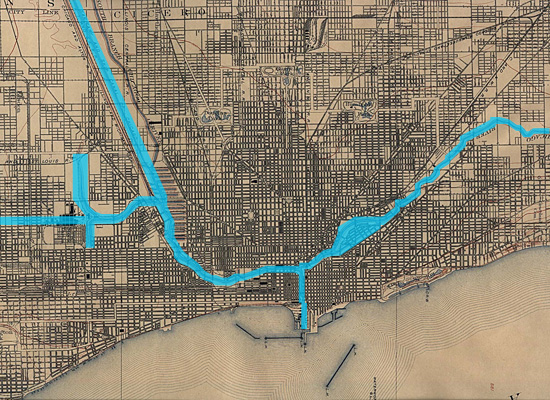
Over a century since retail magnate A. Montgomery Ward sounded the battle cry to defend the city's mandate to keep its lakefront a public common that is “forever open, clear and free of any buildings, or other obstructions whatever,” a similar call to arms was made for the Chicago River, to make it forever free of industries, private developments and sewage.
The ensuing political battles were bruising, and not every building was cleared away, but at least now one can stroll the entire length of the river without having to go up and down flights of stairs or cross streets and fight through traffic. In fact, starting at any point, you can walk or bike or jog along a circuitous path running on both banks of the river and end right where you started.
Along the way, you might encounter kayaking parties setting off from mini-harbors, anglers, community theaters staging avant-garde interpretations of The Odyssey, and triathletes in training. As it is now a baptismal font for future Olympian swimmers, your roundabout will be soundtracked by the ecstatic screams of children frolicking in the waters. During the winter, ice swimming clubs and mobile skating rinks proliferate.
Every four years, the entire river is artificially frozen for a monthlong frost fair.
After a series of negotiations between the United Nations, the U.S. Government, the State of Illinois, the City of Chicago and various ward aldermen and their constituents, sovereignties over several neighborhoods on the South and West sides were transfered to Pacific island nations whose territories had been made inhabitable by rising sea level. Generously compensated, residents of those neighborhoods relocated to the North side.
The new residents, also generously compensated by carbon-intensive nations in perpetuity or until global warming subsides, then set about colonizing their new homeland: an archipelago of extraterritorial enclaves carved out of the city. Some razed everything to the ground, then unearthed and discarded everything that was underground; they tilled the earth anew. Others adapted to and modified what was there, resulting in a patois of Midwestern and Pacific cultural traditions.
Still another nation-in-exile housed their entire neighborhood-state in vast greenhouse complexes: a City of Glass simulating a tropical memory, luminous at night, gleaming during the day.
After scientists had perfected the technique of splicing human DNA into the DNA of a tree, the Bureau of Forestry, the department which is responsible for the more than half a million trees on public right-of-ways, entered into a business partnership with the multi-billion dollar funeral industry to turn the city's urban forest into a living necropolis.
In previous revenue-generating schemes, the perennially cash-strapped city had privatized its airports, toll roads, parking meters &mdash much of its public infrastructure, in fact &mdash which proved disastrous. Not so with this arboreal venture.
The number of trees increased exponentially, even the types of species used. Every tree is lush and vigorous, since not only are they well maintained by caretakers with an eternally flowing revenue stream but also by the bereaved, who in their grief come daily to tend lovingly to the trees and the surrounding planting beds. Tear-drenched anguish has been appropriated into the city beautification program.
The sidewalks, too, look immaculate. Not a single stray candy wrapper can be found, and no one dares urinate on the botanically re-encoded dead. The pavement, after all, is now hallowed ground.
On the Day of the Dead, the streets in the city's many Hispanic neighborhoods become the site of deliriously exuberant block parties. Arbor Day is moved to coincide with Memorial Day.
Later, Google pays exorbitantly for the rights to geospatilize and network the data on all the trees onto its suite of web mapping service applications. Consequently, gravesite visits needn't be performed exclusively in real space; the pilgrimage can now be undertaken virtually. From anywhere and at anytime, you can check up on how the tree is faring, see it grow and mature and bear transgenic fruits, watch as your loved one unconsciously experience an after life.




 Mrs. Blumenthal, 55, of Florida, has been driving around the city for hours now. Since landing at O'Hare, she's taken in the fleeting sights of the northern and western neighborhoods. This afternoon, she'll barrel along the inexorable super-linearity of Western Avenue all the way down to the city limit before making a U-turn and returning to her hotel for the night. Tomorrow and for the rest of the week, she'll make the same perambulations.
 Unrivaled by even the demographic upheavals seen during the Great Migrations of earlier eras, almost overnight the tiny Muslim minority of Chicago exploded to constitute 99.9% of the city's population.