Showing posts with label crowds. Show all posts

Stadium Gang

Studio Gang


Last Friday, Chicago celebrated the Blackhawks' Stanley Cup victory in half a century with a ticker-tape parade in downtown ending with a rally at the foot of the Michigan Avenue bridge, kitty-corner from the recently completed Trump Tower. According to estimates by the city, 2 million people joined in the celebration, all jam packed in ridiculously small street footage.

Studio Gang


A few things:

1) We're curious to find out the reasoning behind the decision to hold the rally in what is essentially a street intersection. The nearby Millennium Park is maybe too precious and dainty to survive the revelry, if it even could contain such a large crowd, but there's Grant Park. It's an incredibly rugged urban park, proving summer after summer that it can handle a stampede of wild festival goers. It's spacious, and there, more people might actually have seen or at least heard what was happening on the stage besides a sea of heads. Then again, why would you need a clear sightline when, even if your view was blocked by a skyscraper, you could probably get instantaneous updates and live feeds from your social network via a mobile device. It's the urban spectacle of the early 20th century amended by the network culture of the early 21st century, perhaps in the process mitigating the monopoly of Victorian and American 19th park typologies for such occasions.

But we'll probably just end up learning that the choice of venue was informed by budgetary issues or simply that the parade ended there.

2) We're also curious to find out what tactics the city would have employed if they had an urban panic on their hands.

3) We were reminded of Studio Gang's proposal for a sports stadium built right smack-dab in middle of the cramped innards of a city.

Studio Gang


Studio Gang


“Designed for the U.S. Pavilion at the 2004 Venice Biennale,” we are told, “the stadium design explores the potential of an urban stadium to accommodate throngs of people and disappear when not in use. The proposed structure would employ a kinetic seating bowl, lifted 30 floors above street level, comprised of a series of transforming seating and support elements, many constructed to fold into the adjacent high-rise buildings in a dense urban center.”

Considering the timeframe of its development, one wonders how much cross-pollination was going on between this project and the then nearly finished Millennium Park, that Frankenstein of programming and constituencies “lifted” above a multi-story garage, as well as New York City's failed bid to host the 2012 Olympics for which, at least in the early proposals, the Olympic Stadium would have been built on the West Side of Manhattan.

Perhaps Studio Gang's hyper-programming was more directly informed, after Burnham, by early 20th century epic proposals to build airports, not just way stations for blimps but humongous concrete surfaces filled with winged vuvuzelas, in the bowels of dense metropolises.

Studio Gang


In any case, since everyone is predicting multiple championships for the Blackhawks in the near future, perhaps a retrofit in the manner of Studio Gang's stadium might be in order for that particular street intersection for future rallies. To use phraseology en vogue, let's do some urban and infrastructural hacking.

On the day of the event, skyscrapers pop out viewing boxes and lower gangplanks bolted with seats. Windows become electrified and aggregate into a giant television screen. Even the Michigan Avenue bridge is raised to reveal more seating areas. Someone will then shout, Trump Tower, transform! And it will!

Not only will 2 million people be then able to fit in but also the entire population of the Chicagoland area. (It might not, however, adequately contain the apocalyptic hysteria during the victory rally to be held for the Cubs after they finally win the World Series.)

When the crowd dissipates, so too will this hyper-intersection.

4) Just in, via @SubMedina via @loudpaper: RUX's vanishing mosque. “What if a mosque was not a building? What if it vanished into the fabric of a city?”


Stadium City

The Labyrinth of Ikea

Ikea


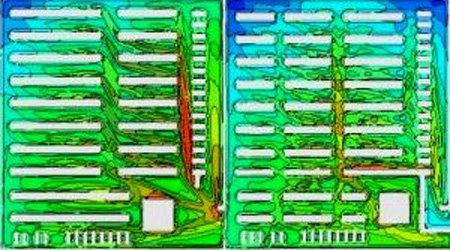
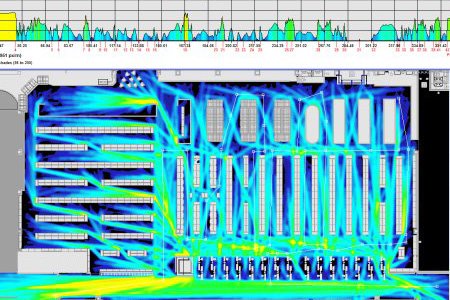
In a windowless room in some nondescript corporate building, but with IKEA furnishings, a clandestine team of crowd physicists and spatial hackers is busy modeling a switching IKEA labyrinth in which these tracings and trajectories of consumerist boredom are whirled unto themselves.

These men who stare at IKEA furniture have been tasked to design a store that can snare cool hunters into a continuous delirium of consumption, only releasing them when bankruptcy is just one shelving unit purchase away. Show rooms seem to flow endlessly into other show rooms, never towards an exit. Countless bounds but boundless. The same corner sofa with the taste-affirming Swedish appellation is passed by a dozen times. On the thirteenth pass, comes overwhelming desire, mortgage payments be damned.

Next door, meanwhile, a fellow employee is also busy crunching numbers. This rogue among rogues has been tasked to weaponize the work of his colleagues, to design an IKEA store as simulant city in which one could trap would-be occupiers and confuse them with self-knotting streams of generic spaces, a labyrinth within labyrinths, until they can be neutralized.


Pedestrian Labyrinth

Pedestrian Labyrinth

Toulouse Crowd


Vis-à-vis the Switching Labyrinth over on BLDGBLOG, here's a recently published paper on a largely ignored aspect of crowd behavior: the need to socialize.

Most current models of crowd displacement assume the individuals to act independently, simply trying to reach their destination without collisions. Using video recordings in urban areas, the team of Guy Theraulaz (Research Center on Animal Cognition, CRCA, University of Toulouse/CNRS), in a straight collaboration with Dirk Helbing of the Swiss Federal Institute of Technology in Zürich, showed the 50 to 70% of pedestrians do not move alone but in small groups of 2 to 4 people. The study of the spatial organisation within these groups reveals that they walk side by side as long as space allows it, but switch to more complex shapes when crowding increases, with the central persons waking behind the others. This leads ot V shapes in groups of three and U shapes in groups of 4. While these configurations facilitate the communication within the group, they slow down the whole group speed. These concave configurations simply make straight walking ahead more tedious and complicate avoidance manoeuvres. On the whole crowd scale this leads to a roughly 17% traffic reduction compared to a situation where pedestrians move independently.


As with many efforts to understand how crowds behave in urban environments, how they are affected, for instance, by bottlenecked entrances, dueling streams of pedestrian traffic and “turbulence” in shoulder-to-shoulder mobs, this new model of crowd dynamics will help urban planners develop safer and more flock-friendly public spaces.

Not quite related but somehow we're compelled to twin it with the above is the CyberWalk.

CyberWalk


Developed by a consortium of several European research labs headquartered at the Max Planck Institute for Biological Cybernetics, it's “an omni-directional treadmill, which together with markerless tracking, optimized control and several perceptual tricks enables humans to walk through Virtual Worlds in a natural and unconstrained fashion.” It's the largest such platform in the world, we are told.

You can see it, or rather the virtual explorer, in action here.

CyberWalk


For a much larger treadmill, cover the ribbon belts with turf, plant a few trees and some shrubs, screw in some decorative boulders and glue in a water feature. Introduce some fauna as well. Then turn on the machine, go for a stroll, and watch as this deterrestrialized earth rotationally reconfigures itself into myriad combinatorial landscapes.

Josh Keyes


Pedestrian Laboratory

UrbanEvac

SportEvac


Here's something we'd like to play around with: SportEvac, a crowd simulation software which realistically model “the chaotic mix of sports fans, security staff, emergency responders and vehicles that interplay during a stadium evacuation.”

Funded in part by the US Department of Homeland Security, it was developed to help security experts plan the safest and quickest way to get fans out following a terrorist attack.

Using blueprints from actual stadiums, [researchers from the University of Southern Mississippi] are creating virtual, 3-D e-stadiums, packed with as many as 70,000 avatars—animated human agents programmed to respond to threats as unpredictably as, well, humans. Security planners will be able to see how 70,000 fans would behave—and misbehave—when spooked by a security threat.

But a SportEvac avatar need not be a sports fan. The simulation includes make-believe stadium workers, first responders, even objects, such as a fire truck or a fans car (screen shot). SportEvac tracks them all, accounting for scenarios both probable and improbable.


Those scenarios include, among other things, panicked fans encountering a wet floor, a wheelchair-bound fan stuck in the crowd, a stubborn aisle-seater, a fan fetching a forgotten purse and an inebriated bleacher bum.

Inevitably, we're led to wonder if SportEvac, or a later plug-in version of it for Rhino and even ArcGIS, can be used to design future stadiums and their environs, to actually embed evacuation strategies into the program itself.

Can SportEvac be scaled up further to ManhattanEvac, in which you have over a million avatars and perhaps an equal number of scenarios to choreograph into an evacuation plan with minimal casualties?

If he were alive today, would Busby Berkeley use a hacked version of SportEvac to pre-viz a musical extravangaza to soothe our weary souls during these troubled times?


Modeling Urban Panic

Public OOoornament

OOoo Chair


Cut two leg-wide holes ergonomically apart, line the holes and the excised disks with recycled plastics, and voilà, you just made your own OOoo Chair.

OOoo Chair


OOoo Chair


“The OOoo Chair is an innovative design solution,” Martina Decker and Peter Yeadon tell us, “that attempts to address the energy and waste problems that are propelled by the furniture production and disposal. The project intends to provoke a change in our behavior, and our way of thinking about furniture, through an elegant economy of means.” Specifically, by (almost) doing away with the chair and embedding it into the architecture, you significantly reduce the energy and material to make it. No object also means no waste and no replacement, which would have its own energy and material requirements.

The OOoo Chair may never be massively implemented to the extent that there would be an appreciable reduction in waste and energy use, but this does not entirely preclude one or two installations at, say, a new restaurant in a museum or a national pavilion at the next “green” world expo. Instead of shimmering scrims, you would have disembodied limbs projecting out of buildings, billowing like a colony of sea anemones siphoning off passing algae. Not interactive performance art, just people eating their lunch. It's the crowd as ornament. They're even as organic as green roofs, as kinetic as wind turbines, and as “green” as those architectural affectations.

On crowds

Hajj


Counting Crowds: it's all politics really.

The Parkless Park: the pageantry of mass psychology.

Crowd Dynamics Ltd.: services include crowd control modeling, evacuation planning, traffic management, pedestrian flow engineering, and queuing analysis.

Pedestrian Laboratory: subjecting human test subjects to urban nightmares in order to make public spaces more user-friendly.

Reconfiguring the Jamarat Bridge

The Kumbh Mela Array: people power, Part I.

The Second Great Leap Forward Pamphlet #14: Queuing: “It's civilised to queue, it's glorious to be polite.”

Modeling Urban Panic: can you predict crowd behavior? If so, what would that mean to the built environment?

Crowded: people power, Part II.

Mapping the Inauguration: imagining a multi-touch urban planning orgy.

Mapping the Inauguration

Armed Forces Inaugural Committee Map


Today in Washington, D.C., at a meeting of the Armed Forces Inaugural Committee, a 40-by-40-foot map being used to plan out next month's presidential inauguration was revealed to the public.

One can't help but be utterly fascinated by the image of military personnel swarming around this map or looking on from above in the bleachers to play out scenarios of what will happen and what might happen in a sort of cartographic war game. They aren't scheming an invasion of some foreign shore but rather the invasion of the nation's capital by the populace.

Parade routes are highlighted, staging areas parceled out, and observation platforms and giant viewing screens placemarked. Critical to any large events, outflow zones are delineated, first aid stations positioned, and emergency evacuations modeled to determine the best way to control the incoming flood and counteract any disastrous perturbation. Equally important to these security measures, a mobile sewage infrastructure (i.e., porta-potties and pump trucks) to be grafted temporarily onto the grid is also being devised.

Armed Forces Inaugural Committee Map


But wouldn't it have been incredible to learn that they are using wall-to-wall (or floor-to-floor) touch screens instead? Or how about that gigantic LCD screen used during the Beijing Olympics Opening Ceremonies? And that this “magic floor” is networked to tablet PCs and Blackberries and maybe even to iPhones? In the stands are federal and local officials working collaboratively and interactively at constructing strategies and counter-strategies, all the while seeing their work evolving right before them on the armory floor. While the majority may be participating in the process semi-remotely, others do so by literally standing on the screen: hands, feet and even whole bodies manipulating the digitized city in an orgy of multi-touch urban planning.

Or what about an airplane hangar retrofitted into the world's biggest CAVE™? During the inauguration, it would serve as the tactical command center.

Of course, all of this would be overkill; the analog map is sufficient enough. But what about when, at some future inauguration of an even more grotesquely popular president-elect, tens of millions of people are expected to descend upon the city on that one day?

Crowded

Crowd Farm


Given the opportunity for yet more indiscriminate self-linking, which undoubtedly is a favorite past-time here on Pruned, we'll take it, even though Crowd Farm, an interesting, albeit less than original, proposal to “harvest the energy of human movement in urban settings” by James Graham and Thaddeus Jusczyk, has been rightly covered by just about everyone during our recent hiatus.

But firstly, in the press release linked to above, you'll read that “a Crowd Farm in Boston's South Station railway terminal would work like this: A responsive sub-flooring system made up of blocks that depress slightly under the force of human steps would be installed beneath the station's main lobby. The slippage of the blocks against one another as people walked would generate power through the principle of the dynamo, a device that converts the energy of motion into that of an electric current.”

And some incredible bits of number crunching: “One step, for instance, can power two 60W light bulbs for one second. But multiply that step by 28,527 and you have enough energy to power a moving train for one second. And if you multiply a single step by 84,162,203? Enough energy to power the launch of a space shuttle.”

We say incredible, because it sounds too good to be true (or perhaps not even good enough?). Did they, for instance, consider energy loss and storage? Will the amount of energy be even enough to offset the cost maintenance, let alone the initial cost? But in any case, we'd truly love to finally see a feasibility test of this technology.

And now to some awesomely indiscriminate self-linking.


Wave Garden by Yusuke Obuchi
The Kumbh Mela Array
The Piezo Array
Airborne-Diving in the Southern Ocean
Modeling Urban Panic

Modeling Urban Panic

Paul Torrens


Paul Torrens is someone after our hearts, for he has developed a realistic computer 3D model that can predict crowd behavior in various spatial configurations.

It can simulate, for instance, how people navigate through busy city streets, shoppers through urban shopping centers, and tourists through unfamiliar landscapes.

Paul Torrens


For the greenish, this has obvious practical applications. According to a press release from Arizona State University, “the project will develop simulations to explore avenues of sustainability in downtown settings, such as how cities can promote walking as an alternative to driving, and how pedestrian flow can be better integrated with transit-oriented development.”

Paul Torrens


Of course, you can also use the 3D model to simulate far less quotidian, obscenely more interesting scenarios.

“The goal of this project is to develop a reusable and behaviorally founded computer model of pedestrian movement and crowd behavior amid dense urban environments, to serve as a test-bed for experimentation,” says Torrens. “The idea is to use the model to test hypotheses, real-world plans and strategies that are not very easy, or are impossible to test in practice.”

Such as the following: 1) simulate how a crowd flees from a burning car toward a single evacuation point; 2) test out how a pathogen might be transmitted through a mobile pedestrian over a short period of time; 3) see how the existing urban grid facilitate or does not facilitate mass evacuation prior to a hurricane landfall or in the event of dirty bomb detonation; 4) design a mall which can compel customers to shop to the point of bankruptcy, to walk obliviously for miles and miles and miles, endlessly to the point of physical exhaustion and even death; 5) identify, if possible, the tell-tale signs of a peaceful crowd about to metamorphosize into a hellish mob; 6) determine how various urban typologies, such as plazas, parks, major arterial streets and banlieues, can be reconfigured in situ into a neutralizing force when crowds do become riotous; and 7) conversely, figure out how one could, through spatial manipulation, inflame a crowd, even a very small one, to set in motion a series of events that culminates into a full scale Revolution or just your average everyday Southeast Asian coup d'état — regime change through landscape architecture.

Paul Torrens


Or you quadruple the population of Chicago. How about 200 million? And into its historic Emerald Necklace system of parks, you drop an al-Qaeda sleeper cell, a pedophile, an Ebola patient, an illegal migrant worker, a swarm of zombies, and Paris Hilton. Then grab a cold one, sit back and watch the landscape descend into chaos. It'll be better than any megablockbuster movie you'll see this summer.

Equally plausible, Chicago does not suffer total critical system failure. In fact, the built environment is surprisingly malleable, so very accommodating to a wide range of extreme radical transformations, that the city actually thrives during this catastrophe and in the end successfully expels the intruders. Far from being a vector of apocalypses, cities will save the world.

In any case, the resulting video from the simulation will be entered into a film festival near you.


The Kumbh Mela Array
Reconfiguring the Jamarat Bridge
The vortex
Advertisement: Crowd Dynamics Ltd.
The Parkless Park Resurfaces
The Parkless Park
Counting Crowds


Subtopia: Urbanization of Panic
City of Sound: Robert Krulwich

The Second Great Leap Forward Pamphlet #14: Queuing

Queue Day in Beijing


While preparations for next year's Beijing Summer Olympics may have wrought incredible changes to the physical landscape of the host city, there has also been an effort to end what officials deemed to be anti-social behaviors in public spaces.

For instance, we learn from BBC News that “China has launched a campaign to try to eradicate queue-jumping.” On the 11th day of every month “volunteers wearing red sashes set up stages in squares and on street corners in more than a dozen districts of the city” where they will choreograph a sort of performance art piece of disconnected, institutional linearity slithering across the urban landscape: millions of people standing in the cold, waiting for buses and trains, and all the while supressing any and all urges to jump in line.
And what's a mass campaign to recondition (or westernized?) the public civility of an entire populace without a slogan: “It's civilised to queue, it's glorious to be polite.” Of course, the French may have something to say about that.
Previous Pamphlets: Spitting, Littering, Farting, Staring, Eating, Slurping, Belching, Sneezing, Cursing, et al.

The Kumbh Mela Array

The last important bathing date of the half Kumbh Mela in Allahabad, India, is set for next Friday, February 16. By some estimates about 60 million people will have participated by the festival's end, and as mindboggling as that number sounds, even more pilgrims are expected to attend the Maha Kumbh Mela in 2013.

Here are some photos from Getty Images, which are copyrighted, hence the empathic branding. Nevertheless, the photos are still quite stunning.

Kumbh Mela

Kumbh Mela

Kumbh Mela

Kumbh Mela

Kumbh Mela

o: how much electricity can be generated from 60-70 million ecstatic people walking, parading, running, crossing pontoon bridges, or simply splashing about? How many kilowatts can a teeming mass of people, roughly equal to the population of France concentrated into an area the size of three Central Parks, produce?

Say, for instance, a network of perambulatory channels is grafted onto Allahabad, the Ganges, and Yamuna, something resembling a High Italian Baroque fountain, or if one were to prefer something vernacular, a Mughal fountain, but in either case, unabashedly flamboyant in design and engineering, crazily interlooping, fractal, and stampede-proof.

It's a water feature writ large. The Maha Kumbh Mela Fountain.

And imagine then that these human aqueducts were somehow rigged to harness the kinetic energy of tens of millions flowing through them: would there be enough electricity produced to power the city for a couple of months? Or perhaps just to power a handful of emergency hospitals and aid stations? A dozen defibrillators?

Kumbh Mela


A couple of things: 1) We sort of like the image of ash-covered naga sadhus only going through certain channels, and women wearing brightly colored saris on other channels: the turmeric yellows over here and the vermillions over there. And petal-bedecked priests carried on floats by their technicolor-hued devotees each taking over a channel. But all are surging towards the water, coiling and recoiling, circling one another on their own separate paths, brushing up against each other, color against color, but without mixing. Until finally, they merge together into a single crowd in the holy rivers.

And 2) while waiting for the next mela, you can probably rig pedestrian subway tunnels to generate electricity from the morning and afternoon rush hour traffic; from sports fans exiting sporting arenas; from the throng of New Year's Eve and Independence Day revelers as they scamper about urban squares, sidewalks, and plazas, if only to power nearby traffic signals and street lights.


The Jersey Array

Reconfiguring the Jamarat Bridge

Jamarat Bridge


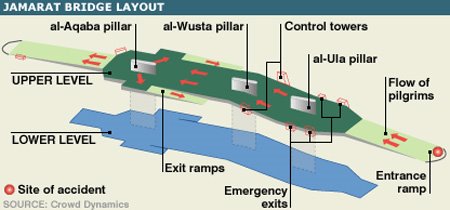
Muslim pilgrims in the next Hajj will see a new four-tiered Jamarat Bridge, a sort of multi-limbed amoeba of reconfigurable inflow and outflow ramps, emergency exits, and subway tunnels directing the flood of supplicants safely through the rocky landscape of Mina, and curiously ornamented with anemone-like efflorescences above the pillars on the upper level.

Jamarat Bridge


The bridge has been the site of numerous disasters in the past, with the most recent one occurring in 1426H (January 2006) when nearly 400 people died during a stampede. The reconstruction, authorities say, will lessen the risk of such disasters from happening in the future.

Jamarat Bridge


Jamarat Bridge


The new design, which was developed in consultation with Dirk Helbing, a professor in crowd dynamics at the Dresden University of Technology, et al., will be complemented by a reorganization of the streets leading up to the bridge, and a time schedule and route assignments as determined in real time through video monitoring and on-site surveillance.

Jamarat Bridge


Jamarat Bridge


Moreover, to ease the flow of people, the jamarat were previously modified into elliptical pillars/walls with the help of Crowd Dynamics Ltd. using similar computer crowd behavior simulations.

Jamarat Bridge


Finally, one has to ask: fifty years from now, when pilgrims visiting Mecca number in the hundreds of millions, will the Jamarat Bridge be rebuilt again to something resembling the 10 Mile Spiral?


The Parkless Park
The vortex
Counting Crowds
Pedestrian Laboratory


Crowd Dynamics Ltd.

Pedestrian Laboratory

PAMELA, the Pedestrian Accessibility and Movement Environment Laboratory

This is PAMELA, or the reconfigurable robotic Pedestrian Accessibility and Movement Environment Laboratory. If you volunteer to be a human guinea pig, you will be subjected to a sort of urban nightmare: headache-inducing lighting; steep inclines to raise heart rates and test the patience of wheelchair users; wet surfaces, gaps and bumps to trip and bruise you; and other people.

But such experiments may result in safer streets and more user-friendly public spaces.

PAMELA, the Pedestrian Accessibility and Movement Environment Laboratory

The vortex

Crowd Flows

The parkless park as imagined by the Graphics and Imaging Laboratory, University of Washington.

Advertisement: Crowd Dynamics Ltd.

Crowd Dynamics

Got problems with crowds?

Do hundreds of people always seem to die from riots and stampede in and around your sporting venues every time the local team looses? And has one of your most sacred religious festivals become a little less of an ecstatic experience due to mass accidental deaths? What about some of your public spaces, have they lost their charm because of congestion?

Are your mass evacuation plans efficient enough? Do you want to be able to quickly device new ones whenever a disaster occur? Or maybe you want to mitigate the effects of the coming worldwide great pandemic?

Would you even like to accommodate even more people in your store and thus make a lot more money?

Do you have £443?

If so, then contact Crowd Dynamics Ltd. now.

Crowd Dynamics

Crowd Dynamics

Crowd Dynamics

Crowd Dynamics

Crowd Dynamics

Crowd Dynamics

Crowd Dynamics

Crowd Dynamics


Counting Crowds
The Parkless Park
The Parkless Park Resurfaces


Reconfiguring the Jamarat Bridge

The Parkless Park Resurfaces

Starlings

From Earth Science Picture of the Day, the amorphous, self-organizing and self-destructing parkless park as breathtakingly enacted by a million European starlings: “During spring in Denmark, at approximately one half an hour before sunset, flocks of more than a million European starlings (Sturnus vulgaris) gather from all corners to join in the incredible formations shown above. This phenomenon is called Black Sun (in Denmark), and can be witnessed in early spring throughout the marshlands of western Denmark, from March through to the middle of April. The starlings migrate from the south and spend the day in the meadows gathering food, sleeping in the reeds during the night.”

Starlings

Starlings

Gorgeous beyond compare.


The Parkless Park
Counting Crowds