Showing posts with label bioremediation. Show all posts

Treating Acid Mine Drainage in Vintondale

AMD&ART Park, Vintondale, Pennsylvania


While writing the post on the Silver Lake reservoir, we were reminded of AMD&ART Park in Vintondale, Pennsylvania.

The two share quite a few in common. For instance, both employ constructed wetlands to detoxify contaminated landscapes. In the case of Silver Lake, it is the Los Angeles River's heady stew of 14 EPA-listed chemical pollutants; AMD&ART, for its part, has targeted acid mine drainage (AMD), hence the name. Additionally, both were conceived as pedagogical landscapes, teaching visitors their respective historical context and technologies. As such, they are occupiable open spaces.

There is one major difference though: AMD&ART Park is actually built and has been in operation for almost 15 years.

AMD&ART Park, Vintondale, Pennsylvania


Beginning in 1994, a multi-disciplinary team — which consisted of T. Allan Comp, a historian and director of the non-profit AMD&ART; Robert Deason, a hydrogeologist; Stacy Levy, a sculptor; AmeriCorps interns; and landscape architect Julie Bargmann, of D.I.R.T. Studio — were tasked to create “a large-scale, artful public space that directly addresses the problems of AMD and much more.”

AMD in the entire Appalachian Region, we read, is “the most widespread water quality problem, as well as a significant economic and social constraint.” Indeed, the EPA has designated it as the biggest environmental problem in the eastern mountains.

Seeping or surging from abandoned coal mines, AMD is the metals-laden water, often acidic, that coats stream beds with orange sediment, killing the bottom of the food chain. Often desolating entire watersheds, these rust colored streams are the consequence of a proud past filled with hard work and dedication in an era that paid little attention to environmental consequences. Today, AMD is a painful reminder of the poverty and economic abandonment that still exists in coal country, the emblematic orange silent signature of dying communities.


The result of the collaboration is, if not innovative, gloriously inspiring.

AMD&ART Park, Vintondale, Pennsylvania


Several discrete elements make up the park. Located in the eastern part is a passive water treatment system and the so-called Litmus Garden. On the other side is a wetland habitat zone and in between is a recreational area. Interspersed throughout are several art installations, hence the second part of the name, though one could call the whole site an art installation itself.

The treatment zone is easily distinguished by a series of 7 keystone-shaped treatment ponds. No cutting edge nanotechnology or the latest transgenic organism or even heavy machinery is used. Turning the highly toxic water into one that you can swim in is done with elementary physics, chemistry and biology. Regular limestone, for instance, is applied instead to lower the water's acidity. Plants simply dying off and decaying in the winter and then returning in the spring also helps to change its pH level. Even gravity is utilized to help suspended metals settle out of the ADM.

AMD&ART Park, Vintondale, Pennsylvania


Meanwhile, the function of each ponds are best explained by the following signs, themselves an important component of the park.

AMD&ART Park, Vintondale, Pennsylvania


Running along these ponds is the Litmus Garden. It plays no role in the water treatment, but it does act as a “visual representation of [the] changing health of the river.”

Small groves or bands of thirteen native tree species were chosen for their autumn foliage colors. In the fall, the Litmus Garden trees will turn deep red around Pond 1 and grade through orange and yellow to blue-green at the end of the treatment system in Pond 6, creating a visual reflection of enhanced water quality — and a great reason for a Vintondale community fall celebration.


It's a horticultural and hydrological rhyming scheme, in other words.

AMD&ART Park, Vintondale, Pennsylvania


Once cleaned or “legal”, the water is then diverted to a seven-acre wetland built on what was “once the busy industrial heart of Vintondale.”

Once an industrial wasteland, our History Wetlands now serve as home to a growing number of plants and animals. Over 10,000 native wetlands plants have been planted, providing a habitat for many insect and bird species including wood ducks, geese, and killdeer. Beaver, fox, deer, and other animals have also been spotted in the wetlands. Ten bat boxes complement the landscape of our wetlands in anticipation of attracting native bats to the area.


From wasteland back into Eden, albeit with the marks of its exile. And this isn't so much a restoration or a reclamation as it is redemption.

But in any case, knowing what wetlands can do, the water can only get cleaner than when it had left the treatment ponds.

AMD&ART Park, Vintondale, Pennsylvania


AMD&ART Park, Vintondale, Pennsylvania


Once the treatment and wetland sections were completed, attention was then turned to developing a multi-purpose, four-acre recreation area that now hosts soccer, baseball, football, and many other outdoor games. “Closely reflecting the aspirations of the very first design meetings with the community, the park is rapidly becoming the new social center of Vintondale, bringing new pride and new activity to the community,” we read.

Parks nowadays seem to be programmed to the hilt and then some. Tomorrow, they'll be asked to save the world.

AMD&ART Park, Vintondale, Pennsylvania


Meanwhile, Eric Reece, author of Lost Mountain, wrote an article about the park for Orion Magazine. There, he speculates that “one of the most important elements of Vintondale may not be its water-treatment system or its sculptural installations, but rather its function as a potential model for many other such projects across the country.” He quotes T. Allen Comp, the park's project director:

AMD&ART is now both the name of a park in Vintondale and the name of an idea, a commitment to interdisciplinary work in the service of community aspirations to fix the environment.


Indeed, as Reece adds, “since the completion of the park, Comp has established the Appalachian Coal Country Watershed Team, a group of fifty-five OSM and VISTA volunteers who are working with the AMD&ART model to engage coal field communities in projects that will remediate damaged waterways and rekindle the power of place.”

The future can truly be bright.

Treating Cancer with Landscape Architecture

Silver Lake Reservoir


An Associated Press article published by The New York Times a couple of months ago told us that the Elysian and Silver Lake, “two reservoirs that supply drinking water” to sections of Los Angeles, were found to contain “high levels of the carcinogen bromate.” When alerted, the city's Department of Water and Power took them both out of service and announced that beginning early this year, they would drain, clean and refill the reservoirs, a process that could last until the summer.

Alternatively, they could consider implementing in parts or in whole a design proposal from out of the Department of Landscape Architecture at the California Polytechnic State University in Pomona.

In this proposal — the product of a collaboration in 2005 between Ken McCown, Andy Wilcox and Kevin Hinders, with research and production assistance from their students — the fenced-off Silver Lake is turned into a public open space hosting one giant bioremediating ecological machine, one that could theoretically render inert the cancer-causing bromate and other pollutants.

Silver Lake Reservoir


The key elements are thus:

1) Presently, the Colorado River and the California Aqueduct supply water to the reservoir, though in the past, the Los Angeles River was the feeder channel. The proposal restores this historical link.

2) A terraced ring canal follows the contour of the reservoir. Installed on the terraces are modular biopods used to bioremediate the 43 pollutants listed by the EPA as present in the Los Angeles River. The cleaned water is then gathered and stored in an underground tank beneath the reservoir before it is put out for use in the city.

It's landscape turned into a therapeutic and preventative medicine, applying natural processes into an artificial apparatus.

Silver Lake Reservoir


Silver Lake Reservoir


Silver Lake Reservoir


Continuing on:

3) The inner wall of that canal forms an internal dam that elevates the water level for the purposes of aesthetics.

4) The whole site is turned into a park, the third largest in a city that “suffers from a paucity of recreation and occupiable public space in comparison to other world cities of similar prominence by almost every means you can measure for this!” Instead of jogging along a fenced periphery, people can do so inside, on top of the canal or on designated paths.

5) The park has an unabashedly pedagogical program. There is a water center, water laboratories, a community center, a library, a pythoremediation garden, and a demonstration and research wetland.

In other words, it's like a Museum of Science and Industry. One wonders if every elementary school kids in the Greater Los Angeles area will be forced to go on field trips there, creating indelible childhood memories that will either be positive or negative ones.

One kid in particular will accidentally get pricked by an irradiated transgenic post-plant. The following morning, he tells his perplexed aunt and uncle that he wants to become a landscape architect when he grows up. That or he mysteriously mutates overnight into a Phytoremediating Superhero. Exactly who or what he will be fighting for and fighting against will be the so-called hero's dilemma. Our awesome screenplay for his story will be turned into a blockbuster movie. The Superfund Trilogy.

Silver Lake Reservoir


In any case, we're anticipating that questions will be asked about the viability of the proposal to detoxify the water and about what actual plants and organisms will the biopods have.

We have this suggestion: to brush up on the scientific literature and perhaps create a plant list of your own in process, browse through this website by John W. Cross (last update: September 27, 2007) on all things phytoremediation. Primarily bibliographical, it only lists books, journals, peer reviewed articles and links to other sites on the topic, but what a list! And though its listings may not be exhaustive, compared to this site and this EPA site, the quantity shouldn't be very intimidating to non-scientists.

Silver Lake Reservoir


Larger versions of the images can be viewed in Ken McCown's Flickr photoset, which also contains other images of the proposal.


Revival Field

Edenfern™

Stephen Hale, Vegetable staticks, or, An account of some statical experiments on the sap in vegetables


Edenfern™ has been shown to remove arsenic deposited in the soil through heavy industrial and agricultural activities. And does so without the benefit of genetic manipulation.

“Discovered in the southeastern U.S. by university researchers, this beautiful fern has a unique ability to soak up arsenic from the ground into its fronds, which may be clipped and disposed of safely. With a powerful cleaning action 200 times stronger than in other plants, the fern quickly lowers soil arsenic levels. Use the edenfern soil cleaner if you know arsenic is in the ground, or even 'just in case' - because whether or not arsenic is present, the fern serves as an attractive addition to a lawn or garden.”

So while they're giving you peace of mind in peace and quiet™, they're sucking out poison and carcinogenic chemicals. Hope they can also suck out shit?

Obviously, I'm repeating myself here, but this fern is worth mentioning again, a second time to point out that it is commercially available exclusively from Edenspace Systems Corporation. The name sounds mildly sinister, nevertheless the company offers actual working solutions to environmental degradation: phytoremediation of lead, uranium, chromium, and other metals, metalloids and organic compounds; brownfield site development and use; wetlands restoration and protection. Etc. No superficial cosmetics. Just heavy duty stuff.

So if you ever need scientific expertise to realize your phytoremediating woodland housing project or need help in capitalizing on your discovery of uranium-eating microbes and bomb-eating mushrooms, give Edenspace a call.

Still, one wishes they sponsor an artist residency program as well.


Edenspace Systems Corporation
Brake Fern and Phytoremediation


Pteris vittata
Revival Field
Not A Cornfield

Pteris vittata

Pteris vittata


Continuing a thread from Revival Field: Pteris vittata, or The Chinese Ladder fern (or even simpler, the brake fern), is a highly efficient arsenic hyperaccumulator. And its phytoextractive property may offer economically viable strategies for arsenic filtration out of water supplies.

From The Annie Appleseed Project: “Arsenic pollution of drinking and irrigation water has emerged as a massive health threat in Bangladesh and India, where wells drilled into aquifers have turned out to be tapping poisoned water.

“When the water is used to irrigate rice paddies, arsenic also accumulates in the crop. According to one estimate, 3,000 people may be dying in Bangladesh each year because of arsenic contamination.

“Elless and his colleagues hope their ferns could be adapted to help purify water in these countries; the method is potentially very cheap, and the plants grow readily in warm, humid climates like those of south-east Asia.

“But Meharg is less optimistic. He points out that the ferns may not be able to cope with the huge volumes of water used for irrigation, and that Bangladesh probably lacks the infrastructure needed to maintain such treatment facilities.

“Still, the approach could be valuable in richer countries. For example, thousands of US water-supply systems exceed the new EPA limit for arsenic concentrations in drinking water of 10 millionths of a gram (10 micrograms) per liter.

“The limit comes into effect in January 2006; the existing limit is five times higher. For small rural communities, fern filtering of arsenic could be just the thing to achieve this new limit economically.”

Pteris vittata


Now the hunt commences for a hyperaccumulator of bad architecture, a vampire plant that can suck the concrete and steel and glass out of failed buildings. Which you can simply sow and cultivate to disintegrate a Corbusian public housing high-rise, perennially empty urban plazas, trillion dollar levees, any Wal-Mart, or any Peter Eisenman. Etc.

I imagine at some point in the future Mel Chin proposing a Revival Field composed of these vampire plants hyperccumulating upon ill-manered museum additions.


Revival Field, or: 7 “terrestrial activities of aliens,” Part III

Revival Field, or: 7 “terrestrial activities of aliens,” Part III

Revival Field / Mel Chin and Rufus L. Chaney

In 1990 artist Mel Chin collaborated with Rufus L. Chaney, a senior research scientist at the US Department of Agriculture, on a project to detoxify a 60-square-foot section of the Pig's Eye landfill, a site in St. Paul, Minnesota, heavily contaminated with zinc, lead, and cadmium.

Using hyperaccumulators, or plants that naturally can extract and store heavy metals, the team was able to gather scientific data on the viability of using these types of plants to clean up polluted soil. Previously, little data outside of lab experiments existed. So for Chaney, Revival Field enabled him to test his research on an actual contaminated landscape for the first time.

Revival Field / Mel Chin and Rufus L. Chaney

Revival Field / Mel Chin and Rufus L. Chaney

Besides advancing science, Chin saw the project in terms of art-making:

If Michelangelo takes a block of marble and starts to make a David, he carves it and carves it. The art is this idea transformed into reality. But what happens if your material isn't marble, but a toxic, dead medium—earth that can't sustain life? Scientific process, not artistic process, has to be the tool. To take that soil and make it live again, to sculpt a diverse ecosystem from it—that to me is beautiful.


Unlike Michelangelo's, however, the process is largely invisible. As a way to spatialize the process, then, “the contaminated earth was fenced in with chain link and subdivided by intersecting paths that form an X.”

It's X marks the spot, a gun's crosshair, the earth turned into a target.

Poisoned landscapes about to be bombarded with botany.

Revival Field / Mel Chin and Rufus L. Chaney

“The project's boundaries are circumscribed by a square. Chin conceives of these overlays as a target, a metaphorical reference to the works pin-point cleanup. The divisions are also functional, separating different varieties of plants from each other for study. In the circular field the intersecting paths create four fields where six types of plants and two pH and two fertilizer tests can occur in each quadrant. The land area between the square and circle functions as a control plot where plants will be seeded with local grasses. The design for revival field facilitates the chemical analysis of each section.”

Revival Field / Mel Chin and Rufus L. Chaney

Revival Field / Mel Chin and Rufus L. Chaney

The initial field experiment finished in 1993. “It showed that Alpine pennycress was best at taking in heavy metals, although neither it nor any of the other plants took in metals fast enough to achieve significant cleansing in 3 years.” But as it is a replicable test, other Revival Fields have been staged elsewhere to determine better and faster accumulators. So stay tuned.


Revival Field @ The Creative Capital Channel
Mel Chin @ Walker Art Center
Mel Chin by PBS Art:21
Rufus L. Chaney


The Technolicious Arboretum
Extreme Horticulture
Woof!
Bouffant Topiary
Protoflorafauna
Edouard François

Biopaver by Joseph Hagerman

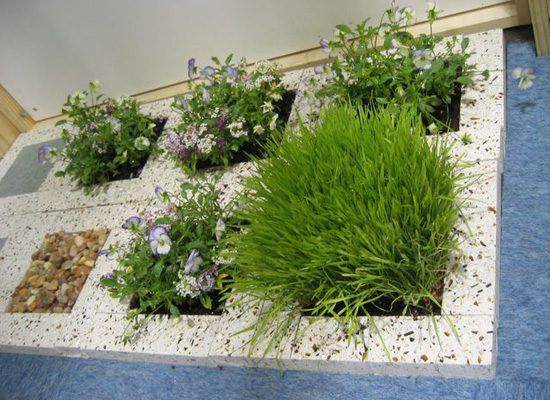
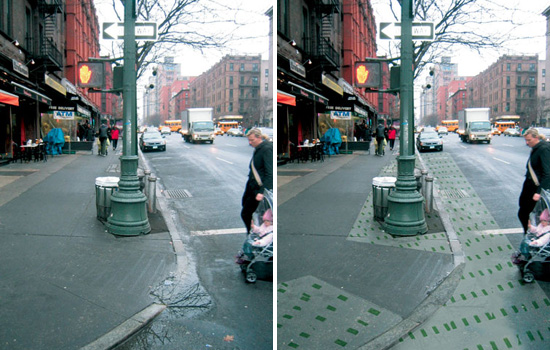
Ecologically sound pavers as alternative to impervious surfaces like asphalt and concrete are nothing new. What is novel about Biopaver, by Columbia graduate student Joseph Hagerman, is the addition of a biological core of phytoremediating plants that filters out pollutants from storm water runoff. It represents a synthesis of techonology, ecological process, and design.

Biopaver by Joseph Hagerman


Biopager by Joseph Hagerman


Biopaver by Joseph Hagerman